Wednesday, February 06, 2013

Wisdom Wednesday: A Grandmother's Love


Catalina (Perrotin) Huesca (1893 - 1998)


"Grandmas hold our tiny hands for just a little while, but our hearts forever."   - Author unknown


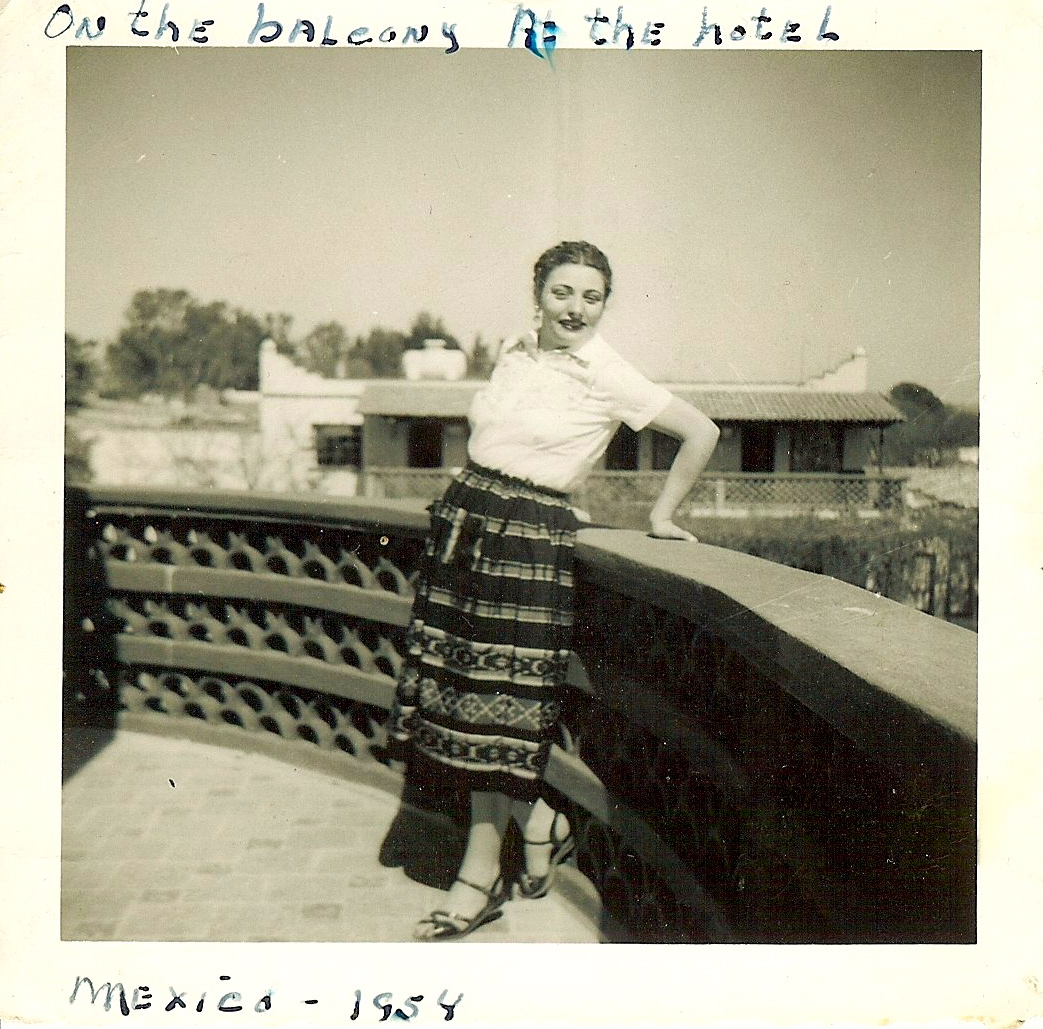
My grandmother, Catalina (Perrotin) Huesca,
Chicago, about 64 years old, 1956.
One of my earliest - and warmest - memories of living with my grandmother, or Abuelita Catalina (Perrotin) Huesca was our first night in her home, as she said her bedtime prayers.

We had moved to Mexico City in early 1964, and we stayed with her at her home for a couple of months while my parents, Gilbert and Joan (Schiavon) Huesca, looked for a suitable home.

Despite her limited space, Abuelita made us feel welcome and right at home.  Her English was no longer what it had been when she spoke it at home with her parents, Francisco and Maria (Amaro) Perrotin, but she still understood it fairly well. She hugged and kissed us tenderly and laughed along with us as we sat in her tiny painted wooden chairs.  

We could not have been happier to have so much attention.   I think we somehow figured out in our own childish way that a grandmother's love knows no language barriers. 

My parents and my two youngest sisters slept in the living room.  I thought my other sister and I were the lucky ones when we found out we would get to sleep with our grandmother in her large, soft bed.  

She was deeply religious. Wrapped in her black rebozo, or shawl over a soft flannel nightgown and wearing thick dark socks to keep her legs and feet warm, she tucked us gently into bed, turned off the main light, and lit a couple of candles in tall red glass jars covered with images of the Sacred Heart and Saint Michael the Archangel.    

The candles now being the only light in the room, she knelt at her bedside and recited the Rosary. This was followed by various prayers, first to the Sacred Heart of Jesus, then to Virgin of Guadalupe, and lastly to Saint Martin de Porres, her favorite saint.  Walking purposefully around the room, she stopped at each photograph and reverently lit the votive candles in front of them.  The pictures were beautiful and numerous; they covered all the walls of her room, her two dressers, and the bedside tables. 

She prayed for the people in each of the pictures:  her parents and grandparents, her beloved husband Cayetano, their children and grandchildren, and her beloved sister Blanca Perrotin. She seemed to leave no one out, even though ours was a large extended family.


About 30 - 45 minutes later, Abuelita climbed into bed with us.  I think she was surprised I was still awake, especially after our long journey, but I could not take my eyes off her.  The toasty warmth of the tin heater in the corner, the flickering candles in the room and the dancing shadows on the wall, together with the family pictures and the images of God and all the saints smiling down on us made me feel safe and loved and blessed.  I had never  witnessed anyone talk to God as intimately before this night.  We pulled the covers way up to our foreheads and cuddled together in the soft glow as we fell asleep, my grandmother stroking my head.


Copyright ©  2013  Linda Huesca Tully

Did you know, or are you a member of the Huesca or Perrotin families ?  If so, share your memories and comments below.

Tuesday, February 05, 2013

Traveling Tuesday: South of the Border Bound


CC courtesy of Eva Luedin on Flickr
Decisions to move are not made lightly, especially when a large family and a great distance is involved. My parents thought long and hard about leaving Chicago, where my mother had been born and lived all her life, and transplanting our roots to Mexico City in early 1964.

The trip to Mexico took about a week.  My father, the sole driver in the family, was the captain of our station wagon-cum-ship, and my mother was the designated navigator.  We four little girls, ages 2 through 9, had a job, too.  As the dutiful passengers on this journey, we were to sit side-by-side in the back bench seat and enjoy the ride.


My father spent a couple of weeks building a large, lidded box to fit the carrier on top of the Falcon, and he painted it pale yellow to match the car. Inside, he and my mother packed our clothes, dishes, photo albums, and special collectibles that were dear to my mother.  My grandmother, Alice (McGinnis) Schiavon, had died just a year earlier of complications from diabetes, and my mother made sure to bring along things that reminded her of her beloved late mother.  

My mother used her creative talents to sew a set of cream-colored curtains for the windows, to shelter us from the strong sun and to give us some privacy when we pulled over to the side of the road to rest.  She was so proud of them.  We all thought we had the best-looking car a family could have.  

My mother also sewed cloth bags for each of us children, into which she placed books, puzzles, road games, activity books, and other surprises.  She did this whenever we went on long road trips, and we looked forward to receiving the surprise bags, never knowing what treasures they would contain for our journey.

For this special trip, we received extra books.  Mine included Little Women by Louisa May Alcott, The Five Little Peppers and How They Grew by Margaret Sidney, and the first of many Nancy Drew mysteries, The Secret of the Old Clock, by Carolyn Keene.  I tucked another book into my bag:  a slim pocket size English-Spanish dictionary.  It was a going-away gift from one of my classmates in Mrs. Prokopeak's fourth grade class at Saint Philip Neri School.  

We had a large cooler filled with ham and cheese sandwiches, milk, and other snacks.  It sat in the back seat, in the middle so my two youngest sisters could put their short little feet on top, and it came in handy for lots of games of tic-tac-toe and Old Maid cards.

Besides a bundle of large road maps she kept up in the front seat, my mother carried something else that  would have been a bit unusual for a long road trip.  She took the Lady Plate, a stunning, very large French porcelain plate that she and my grandmother Alice had bought on their trip to Europe in 1950.  After making its first appearance in the Schiavon family antiques gallery, the Lady Plate graced my grandmother's living room for many years until she gave it to my mother just before she died.  

My mother wrapped her treasure carefully in thick blankets and held it on her lap during the entire trip.  To this day, I still do not know how she managed to keep it intact all the way down to Mexico and back again to California some years later.

My father, understanding my mother's sentimental attachment to this reminder of her mother, checked his maps and planned our route to Mexico via the Pan-American Highway, entering Mexico through the U.S. border town of Laredo, Texas, and traveling through the Mexican cities of Nuevo Laredo, Monterrey, Ciudad Victoria, Pachuca, and eventually into the capital, Mexico City, also known as the Federal District.  The road was said to be wider in many places, safer, and better maintained than most - a good bet for getting one's wife, squirmy children, and fragile cargo to their final destination happy and in one piece.

Map of the Pan-American Highway, also known
as the Inter-American Highway.
Courtesy Wikipedia, Creative Commons
To take advantage of time, my father drove from very early in the morning until late afternoon, so we would have ample time to play and wear ourselves out at the motels along the way.  Between asking our parents if we were "there" yet, we called out state license plates and every bridge we crossed.  We read the Burma Shave signs on the side of the roads in the South.  As we crossed the border into Mexico, we marveled at the jungles we passed through and squealed with delight at the wild monkeys at some of the rest stops. 

Although this highway was better than most in Mexico, it could be dangerous in places.  We traversed many a windy road, climbing mountains thousands of feet high, my mother calling out the signs and hazards along the way:  "Sharp curve ahead," "Semi-truck coming up on your left," "Narrow lane ahead," and "Avalanche area ahead."  This last warning was the worst one.  My mother would look back at us and repeat it, "Avalanche area ahead - Shhhhh!"  She wanted us to remain silent while my father tried to concentrate on the road.  It was not always easy for us to keep quiet (especially when we were fighting), but we did our best, holding our breath until we were out of the danger zone.  I can't speak for my sisters, but I was afraid that if we so much as let a peep out of our mouths, the sound waves of our voices might trigger a loose rock, causing more to come tumbling down on top of us.  

It may not have been too far from the truth, for we did see a number of piles of loose rock on some of the higher passes. 

We also saw quite a few disabled cars on the road.  A most sobering sight was the occasional wooden crucifix that appeared here and there on the road, enshrined in pictures and flowers as memorials of other travelers who had not gotten to their intended destination but to their final resting place instead.  Whenever we saw this, my mother would lead the family in making the sign of cross and saying a prayer for the departed.

We did the same whenever we heard sirens, as these usually meant an ambulance passing by.  As we neared Mexico City, we heard a gaggle of loud sirens, and my mother called back to us to get ready to bow our heads and make the sign of the cross for whomever was inside the ambulance.  Imagine our surprise when the parade of sirens turned out not to be ambulances but a convoy carrying the President of Mexico himself, Adolfo Lopez Mateos!  He started to wave at our car as his limousine passed us but dropped his jaw when he saw six gringos bowing their heads and blessing themselves in unison!  My father recognized the President instantly and had quite a funny story to tell the relatives when we arrived at my grandmother's house in Mexico City a few hours later.

It was an emotional arrival.  My father's four brothers and five sisters and their families were all there, except for my Uncle Carlos, who by then was living in Chicago with his own wife and family.  We had been to Mexico once or twice before on summer vacations, but we could not believe what a large family we had - and every single one of them seemed to be hugging us, crying and speaking to us in Spanish.  My sisters and I could not understand what they were saying yet, but it didn't matter.  We already felt right at home.


Copyright ©  2013  Linda Huesca Tully

Did you know, or are you a member of the Schiavon or Huesca families or any of the people mentioned in this story?  Do you remember a special family road trip?  If so, share your memories and comments below.


Monday, February 04, 2013

Madness Monday: Cold War Mania


Bert the Turtle taught me and other children of the
1950s and 1960s how to protect ourselves in the event
of a nuclear bomb.  1952, Creative Commons, originally
published by the U.S. Government and Archer Productions.
Though life on South Luella Avenue in the early 1960s was indeed full of innocence and bliss for the most part, we were not untouched by the world around us. In my case, this became evident at bedtime. While some young children had trouble getting to sleep at night because they were afraid of monsters in the closet, I was afraid there were Russians under my bed.

The "Red Scare" of the 1940s and 50s spilled into the early 1960s with a vengeance, as talk of the threat of communism  and nuclear annihilation permeated the airwaves and became a household topic of conversation.  My parents wisely refrained from talking about it around my sisters and me.  Despite their best efforts, however, it was hard to miss the nation's preoccupation with the threat of an atomic attack.

In 1961, President John F. Kennedy made a speech exhorting American citizens to build fallout shelters to protect themselves in the event of a nuclear attack by the Russians.   The idea of a fallout shelter was to give people a safe place to evacuate where they could stay for as many as two weeks.

A 1959 booklet, The Family Fallout Shelter, published by the federal Office of Civil and Defense Mobilization, stated, "The enemy would try to knock out our retaliatory power.   He might also try to destroy our cities. No one can be sure how far the enemy would go."  It went on to give detailed instructions on how to build five different kinds of fallout shelters, including a concrete block basement shelter for about $150 - 200. 

This latter shelter was the one my father, Gilbert Huesca, set out to build in our basement.  I don't remember watching him build it, but I do recall we had a wall of concrete blocks partitioning off part of the basement.  The wall did not go all the way to the ceiling, as I was able to climb on a table and look over the top.  Apparently, there was supposed to be a roof on the shelter eventually, but I do not think my father got that far.

The booklet also gave brief tips on what the family should do in the event they had to use the shelter:


Families with children will have particular problems.  They should provide for simple recreation.

There should be a task for everyone and these tasks should be rotated.  Part of the family should be sleeping while the rest is awake.


To break the monotony it may be necessary to invent tasks that will keep the family busy.  Records such as diaries can be kept.


The survival of the family will depend largely on information received by radio.  A record should be kept of the information and instructions, including the time and date of broadcast.  


Family rationing probably will be necessary.


My mother, Joan (Schiavon) Huesca, set about stocking our basement shelter with canned food, powdered milk, water, medicine, toys, cots, and other supplies.  My father built long shelves along the concrete wall, and my mother filled each and every one, meticulously labeling each container with descriptions and expiration dates.


We children also did our patriotic part.  At school, we participated in safety drills, as Bert the Turtle taught us how to "duck and cover" under our desks, in hallways, or against walls in the event of an atomic bomb explosion.  We all knew well that the sound of the air raid siren meant we had to drop to ground immediately in a crouching position, covering the back of our necks and faces to protect ourselves against injury.   We accepted this quite matter-of-factly, probably because we had never known anything else; yet like typical children, we sometimes needed that extra bit of assurance that we would be safe.  For me, that meant asking my mommy and daddy to look under my bed every night to make sure there were no "enemy" Russians waiting to snatch me away.  

Civil Defense shelters, marked by three yellow triangles on a black circle, were also commonplace at the time.  An article in the Chicago Reader noted that at one time the city had some 1,482 shelters that could accommodate almost two million people.

After the Cuban Missile Crisis of 1962 had subsided, there remained speculation that the Russians had nuclear missiles aimed at major American cities, Chicago being one of them.  My mother and father decided that we would be safer living in Mexico, away from the perceived threat of nuclear destruction.   They did not want to frighten my sisters and me, so they announced to us that we were moving to Mexico City, so we could get to know our relatives and learn a new language and another culture, and where the climate would be much warmer than frigid Chicago.

On a very early morning in 1964, we piled into our yellow 1962 Ford Falcon station wagon.  My father had built a large wooden box to fit the roof carrier; inside it he and my mother had packed everything we would take for this new chapter of our life.  It took about a week to drive from Chicago to Mexico City, where my grandmother, aunts, uncles, and cousins welcomed us with open arms.

We would not learn the real reason we had left Chicago until my father told us three decades later.

Though technology has changed our world drastically since the 1960s, some things have not changed all that much.  We are still the same human beings we were back then.  We still worry about the future.  We try to prepare for the unknown.  We do the best we can within the realm of possibility to protect our loved ones.

My parents acted in our best interest and sacrificed greatly on our behalf.  My father had to give up his job.  My mother had to leave her parents, her brother, and all her friends.  They left a beautiful home to start over again.

We lived in Mexico City for three years before returning eventually to the States.  I will be forever grateful to my parents for our life-changing move, which left an indelibly positive influence on the people we would become.  Living in Mexico exposed us to opportunities we never could have imagined.  For me, this meant getting to know my relatives and developing strong and intimate bonds with them that continue to this day, making new friends, attending a Mexican school and learning through a new perspective, and learning to speak Spanish fluently.   .

Life happens in mysterious ways.  Though I may have feared the Russians in my childhood, maybe today in some strange way I have them to thank for that, too.


Copyright ©  2013  Linda Huesca Tully

Did you know, or are you a member of the Schiavon or Huesca families? Were you or was someone in your family affected by the Cuban Missile Crisis or the Cold War era?  Share your recollections and comments below.


Sunday, February 03, 2013

Sentimental Sunday: Life on South Luella Avenue


I was just turning four years old in 1959, when our family moved to a two-flat brown brick home owned by my maternal grandparents at 7123 South Luella Avenue in Chicago.

We moved into this home on Chicago's South Side in 1959.
This photo shows it as it looked a few years ago.
My Nana and Baba, Alice (McGinnis) and Ralph Schiavon, lived in the upper flat and we lived in the lower one.  Our dwellings were connected by two sets of stairways, one in the foyer of the house and the other at rear side door.  There was a small crescent-shaped telephone table in the entrance.  A black rotary phone sat on top, while a thick volume of the Chicago Telephone Directory rested in a cubbyhole made just for it.  To my young eyes, it was just the right place for a small girl to sit on the bench with a book and read.

My first memory of our house is of a bright yellow and green swing set and slide and a matching sandbox in the backyard.  When we moved in, I thought the set was my birthday present, but I think it was just coincidence. Nana and Baba had bought it to make my sisters and me feel welcome.

Not long after we arrived, they also bought us a child-size Swiss-made surrey with a fringe on top.  It was a miniature version of the surrey in the 1955 movie, Oklahoma! and had two black leather bench seats and a red and white striped canopy.  We took turns pedaling and steering it, most of the time "driving" down the sidewalk on Luella Avenue.  Sometimes our parents took all of us on longer excursions to the lake, pushing the surrey when our legs got tired.


My mother, Joan (Schiavon) Huesca, pushing my
little sister and me down the driveway on my tricycle,
Chicago, 1959.
We quickly made friends with the other children on the block.  Arne and Renelva Schairer and their (then) five children lived on one side of our house, and Joe and Mary Lee Hanlon and their son Jimmy lived on the other side.  We spent our days outside, moving from one house to another like a little swarm of bees, riding our tricycles up and down the long driveways, playing dolls, catching bugs, and building castles in the sandbox with our playmates.


Our family loved parades. Whenever we got home from the city parades on Decoration Day (now known as Memorial Day), Flag Day, and Independence Day, my sisters and I could not wait to decorate our tricycles and the surrey.  Armed with child-size American flags and Uncle Sam hats and blowing party horns and banging makeshift drums, we joined our neighbors and marched up and down the sidewalk, singing "Yankee Doodle Dandy," "My Country 'Tis of Thee," and "God Bless America," as our parents sat nearby to watch.

Our block was lined with beautiful homes. Near the corner was a large house with a stone facade that to us looked like a castle.  Someone told us it had a ballroom upstairs, so we decided it had to belong to royalty of some kind.  I used to walk past the house on my way to school every day, and I never passed the house without gazing in awe at the second floor.

A widow named Emily Scheurer lived alone two doors down from us in a fairy-tale Tudor-style house.  The other kids were afraid of her and thought she was a witch, and we used to run past her house as fast as we could. When I was about five years old, the witch invited me into her house for a piece of apple pie she had just made.  Though I didn't want to go inside, I wanted to be polite.  I went inside, sure I was marching to my doom, like the fairy tales I liked so much.  My friends thought that was the last they would see of me. 

As I am here to tell the tale, it should be no surprise that I ate the pie, liked it, and survived.  The real twist to the tale would come several years later after my Nana died and my Baba married the witch...er, Mrs. Scheurer.  She must have been a nice lady, after all.


Copyright ©  2013  Linda Huesca Tully

Did you know, or are you a member of the Schiavon or Huesca families or any of the people mentioned in this story? Do you have fond memories of your childhood home?  If so, share your memories and comments below.


Saturday, February 02, 2013

Shopping Saturday: Adventures in Spanish


Joan Joyce (Schiavon) Huesca  (1928 - 1987)


Joan Joyce (Schiavon) Huesca, at the country  home of my
Uncle Enrique and Aunt Mercedes "Meche" Huesca,
Cuernavaca, Morelos, Mexico, August 1987.
My mother went to the corner store one day while in Mexico City to buy some hair gel.  After hunting unsuccessfully for it, she asked the clerk behind the counter for help.

"Discúlpame, Señorita," - Excuse me, Miss, she began in broken Spanish.  "Pero no encontrar goma para mi caballo."

The clerk gave my mother a strange look.  "No, Señora," she replied in Spanish.  "I think you've come to the wrong place.  We don't sell that here.  Try a feed store."

My mother, pointing to her hair, insisted.

"Oh, cabello," smiled the clerk, and found the hair gel.  It turned out that my mother had asked for gel for her horse.

My mother believed it was important to be humble and to learn from one's mistakes.  She made her fair share of these in her efforts to communicate in Spanish, but it never seemed to phase her.  She often said she wished she'd paid more attention during her high school Spanish classes.  But back then she hadn't known that one day she would travel to and eventually live in the homeland of the love of her life, my father.

By the time our family moved from Chicago to Mexico City in the 1960s, my mother had learned enough Spanish to carry on a conversation.  She would not practice it with us for fear of our repeating her errors.  Because she and my father felt strongly that we should learn to speak the language well, they sent us to public school and chose to live near family rather than in one of the expat neighborhoods of Mexico City, where we would have spoken mostly English.  As a result, the only place we spoke English was at home.

While my sisters and I had the advantage of learning Spanish at school, my mother had to learn the language through her everyday errands and visits.  Her teachers were our relatives, neighbors, and merchants.  She learned much of her vocabulary by trial and error, improvised sign language, and a sense of humor.

One year she wanted to buy my father some handkerchieves for his birthday.  It took her several tries before the store clerk realized what she really wanted, my mother having asked for diapers - pañales - instead of pañuelos - for her husband.

One of her daily stops was at the butcher shop, which opened out to the street.  My grandmother had recommended the place for its fresh meats, and the constant line of housewives streaming out the door seemed to echo this opinion.

My mother would go there in the late morning.  Sometimes she could point to the cut of meat she wanted if it was on display, and other times she knew the word for the cut of meat she wanted.  For the cuts she wanted but could not see or translate, she had to work her way around the word, using sign language and imitating animal sounds until she could communicate what she wanted.

If she wanted ground beef to make hamburgers, she would make a mooing sound (until she learned the word for cow, vaca) and roll her fists together in a grinding motion. She made the same gesture if she wanted pork sausage but would grunt like a pig.   If she wanted chicken legs, she would say "pollo," or chicken, and point to her leg. The butcher would wait patiently for her little dance and fill her order with a smile.

Of course, this routine provided great entertainment for the other shoppers awaiting their turn, as well as for the passers-by who would stop to watch. My mother usually laughed as hard as they did.  On her way out of the shop, the others often patted her on the shoulder good-naturedly, bidding her Adios until the next day.  

This went on for about a month, until the day before Easter Sunday, when she needed to buy a ham for our traditional family dinner.  As she approached the counter with a cheery Buenos Días to the butcher, he said to her in perfect, unaccented English, "Good morning, ma'am.  What'll it be today?"

My dear mother could not believe her ears and gaped at the man.  "You speak English!" She exclaimed incredulously.

"I lived in Detroit for 30 years," he said.

"You mean all this time, you knew what I wanted, and you just let me..." she started, flabbergasted.  She didn't know whether to laugh or cry.

"I know. I'm sorry. I felt really guilty about letting you go on like that.  But you were good for business!"  the butcher said, "And my customers love you!"

Indeed, his customers - and many who met my mother throughout the years - were charmed by her determined and unabashed efforts to communicate in Spanish.  She had long ago fallen in love with Mexican history and culture.  She found that people were forgiving of her when she made mistakes, because they knew she was sincere and was making an effort to talk to them. Through her example, I learned that to understand people of different cultures, you have to relax and be yourself, try your best to speak their language, be willing to take risks, accept that you will make mistakes, and not take yourself too seriously.

And one more thing:  relish the adventure.

Copyright ©  2013  Linda Huesca Tully

Did you know, or are you a member of the Schiavon or Huesca families? Do you have a story about your own adventures in a foreign language?  If so, share your memories and comments below.


Friday, February 01, 2013

Family Recipe Friday: My Mother's Bread Pudding


Joan Joyce (Schiavon) Huesca (1928 - 1987)


Bread Pudding
Wikipedia Commons Image, commons.wikepedia.org

Bread pudding in our house was a treat for us - and a thrifty dessert.  My mother, a child of the Great Depression, knew how to stretch ingredients for our family of six.  I believe this recipe came from a 1950s series of cookbooks she owned called the Mary Margaret McBride Encyclopedia of Cooking.  She used to recall the bread pudding her maternal grandmother, Mary Jane (Gaffney) McGinnis, made for her in the early 1930s, and whenever she made her own version for us, she would slice it into pieces while it was still warm and sprinkle a bit of sugar on top before serving it.

Though at first glance the amounts of milk and bread crumbs may look anything but thrifty, the trick is in how you improvise.  

Sometimes when money was tight for our young and growing family, the milk my mother used to make bread pudding came from a box.   Not only does powdered milk cost much less than fresh milk, but it also keeps longer and needs no refrigeration.  She made the bread cubes from dried stale bread.

Maybe it is a good thing that I do not see bread pudding on restaurant menus much these days.  That way, I know that if I really want a taste of my childhood, I can re-create it in my own kitchen, complete with memories of my mother's love that are as sweet and warm as this delightful pudding.

My Mother's Bread Pudding


2 eggs, beaten
1/4 cup sugar
1/2 tsp. salt
1 tsp. vanilla
1/4 tsp. nutmeg
4 cups milk, scalded
1/4 cup butter, softened
2 cups bread cubes

Combine eggs, sugar, salt, vanilla, and nutmeg.  Add scalded milk and butter; mix well.  Add bread cubes and pour into buttered baking dish.  Set baking dish in a pan of hot water.  Bake at 350 degrees for 45 - 50 minutes, or until a knife inserted in center comes out clean. Serve warm or cold with cream, plain or whipped, hard sauce, or lemon sauce.  Top with ice cream if desired.  Cake or gingerbread may be substituted for bread crumbs.

Serves 6.


Copyright ©  2013  Linda Huesca Tully

Did you know, or are you a member of the Gaffney, Schiavon, or Huesca families?  Do you remember a special family recipe?  If so, share your memories and comments below.


Thursday, January 17, 2013

Thankful Thursday - Grateful and Paying it Forward


Last week my fellow family historian, Kathy at Abbie and Eveline, surprised me by awarding me the "Liebster Blog Award."  Kathy writes heartfelt stories about her two grandmothers, Abbie Webber and Eveline Coates, the stories they shared with her, and their wise influence on her life.  I am most grateful for her kind recognition and am honored that she would nominate me.

"Liebster" is the German word for "dearest."  The award comes with a few rules, with which I am happy to oblige:

1.   Thank the one who nominated you by linking back.

2.   Nominate five blogs with less than 200 followers.

3.   Let the nominees know by leaving a comment at their sites.

4.  Add the award image to your own site.


Ah...five blogs?  It would be easy to nominate even more than that!  There are a lot of wonderful blogs out there, but here are some of my favorites, in alphabetical order.

1.  A Family Tapestry - Jacqi Stevens' writing is engaging and thoughtful, and she covers her subjects with a thoroughness that makes you feel as if you had known them as well as she does.

2. A Sense of Family - Shelly Bishop has already received this award, but it will be no surprise after you read her article, A Kinder, Gentler Approach to Genealogy Goals.  She points out that these goals are not about the pressure one sometimes feels to write or do something, but in fact they are ways of prioritizing where we want - or need - to spend our time.

3.  Jana's Genealogy and Family History Blog  - Jana Last has posted two articles lately that really caught my attention.  One of these was on how to watermark photographs, so they will remain yours even if someone copies them from your website or blog.  The other was on adding a "landing page" for a particular branch or event from your geneablog.  This has gotten me thinking about adding a landing page of my own...stay tuned.

4.  Pages from the Ancestry Binders - Susan Mosey recently wrote a "Wisdom Wednesday" post about her father's "Analysis of Worries," advice from her late father on a scrap of paper she has kept for many years.  It should be required reading for everyone.

5.  Sitting Under the Family Tree - Cchidlow posted a fascinating article on the background behind some of the traditions of Christmas around the world.  Christmas may be behind us, but read Black Eyed Peas and Pickles now and you'll be "in the know" for next year.

6.  Taos Sunflower - Although this is not a blog about genealogy, it is a favorite of mine.  Martie (full disclosure: a distant cousin of my husband's) is an artist, writer, and photographer who writes about the things that matter most to her - her family, travel, nature, and the little beauties she finds in life.


It seems that this is "award" season for blogs.  Some of these bloggers have already received this award (or others), while others have not.  In any case, this will be my small way of letting them know just how much I appreciate them and the ways their writing has touched me.  If you're looking for some good reads, you can be sure that a simple click on one of the blogs above will take you to the right place.


Copyright ©  2013  Linda Huesca Tully


Share your memories and comments below.


Sunday, January 13, 2013

Sentimental Sunday: Master of the Game


Gilbert Cayetano Huesca (1915 - 2009)


My father, Gilbert Huesca, and me, riding the elevator
up to his apartment after his birthday dinner,
November 2008, Santa Clara, California.
Dear Daddy,

To know you well was to understand your great love for the game of chess and how it figured into your outlook on life.

You learned to play chess at the feet of your own father, an entrepreneur in eastern Mexico who successfully ran several businesses to support your mother, and you and all your brothers and sisters.  One of those businesses was a casino – not the kind with slot machines we see today – but with game tables where you could play cards or chess.  There was a U-shaped table in the center of the game room, where up to a dozen people would sit in front of as many chessboards. Your father - my Abuelito or grandfather, Jose Gil Cayetano Huesca, would slowly work his way around the table, stopping at each board, and playing each of the games simultaneously.  Maybe it was because he was the father of eleven that he could keep all those games straight, or maybe he had a photographic memory. In any case, all the Huesca children were expected to learn chess at an early age, and as the years passed, you and your brothers and sisters honed your skills and took turns helping your father at the game table.

You fell in love with the game. You got so good that you’d play blindfolded, two or three games at a time, and as you grew up you played in quite a few chess tournaments throughout Veracruz state, becoming known for your deliberate coolness and expertise.

When the girls and I were young, you tried to interest us in the game.  I can’t speak for them, but I found it too complicated.   It seemed too mathematical – not one of my strong suits – not to mention tedious and slow. I didn't want to think that much. For some reason, you didn’t seem to mind, and over the years you found other willing chess partners – your brothers, your grandchildren, your neighbor. You took great pleasure in sharing your knowledge of the game with others, extolling the virtues of the game and encouraging them to always play their best.   

You also believed in playing all the way through to the end, no matter how long it took. Do you remember what happened several years ago, when you came with the family to Palm Sunday Mass, only to find that no one else had gotten to church yet?  We were an hour late!  It was Daylight Savings Time, and we had forgotten to turn our clocks forward.  

We drove to Santana Row, a nearby outdoor shopping center, to take a stroll and while away the hour until the next Mass.  The kids ran ahead of their "Baba" to a life-size chessboard in the center island.  We all knew what was coming.  You smiled broadly as Michael and Kevin tossed a coin and Kevin got the first game.  The rest of us plopped down in the nearby seats to watch.  Before long, a small crowd gathered to watch as the two of you slowly circled the chessboard, deep in thought.  It was not to be a quick game, and we were not be be very good Catholics that day, as we ended up missing the next Mass.  

One day, after you moved in with us in early March 2009, I watched you look longingly at a chess board you had given Kevin.  It was a hand-chiseled black and white alabaster set you had carried back on the plane from one of your trips to Mexico, but now it sat in our family room, dusty and unused.  I asked if you would try to teach me again, and your face lit up.  Together we polished each piece as you patiently explained what it was called, what its purpose was in the game, its relationship to the other pieces on the board, and how to move it.

As we began to play, you spoke passionately of the lessons you had learned from a lifetime of playing.

It is a game of manners and strategy, you said, one that charges its players to look not just at a single piece or move but at the board as a whole.  Keep your goal in mind.  Have a plan to get there but be flexible.  Understand the value of each piece and its function.  Protect your pieces and help them work together.  Pay attention to the moves – and the mood – of your opponent.  Consider all the possibilities and their outcomes.  Choose your moves carefully, but act decisively and deliberately, and have a good reason for whatever you do.  Think first – you can’t take back your actions. Be responsible for your actions and accept the consequences gracefully and gratefully.  Learn from your mistakes.   Respect the rules and play fairly.  Never pressure or take advantage of your opponent, but try to help him or her if the opportunity arises.  If you win, be humble.  And whether you win or lose, thank your partner for a game well-played.

That first game we played was one I will always remember.  You won, of course, but you let me win the second game, probably so I'd want to play again.  It wasn't necessary, because I enjoyed it so much.  We got to play a few more games before you went home to be with God that June.  Still, on that first day, not only did I finally see the beauty of the game you had spoken of all these years, but I also discovered that your philosophy of life was intertwined with the game itself.

Chess, like life, is a beautiful game that incorporates planning, integrity, and honor.  You understood that and wanted us to understand it, too.  You showed us how to look at the big picture, think deliberately, be responsible for our actions, learn from our mistakes, and look out for one another - always in a spirit of thoughtfulness, fairness, humility, and gratitude.   

You lived as you played, and you were a master at the game.  

My dear Daddy, for this and so much more - thank you.

                                                                    All my love,

                                                                    Linda


Copyright ©  2013  Linda Huesca Tully


Friday, January 11, 2013

Family Recipe Friday: Abuelita's Mexican Rice


María Angela Catalina (Perrotin) Huesca  
(1893 - 1998)


My grandmother or "Abuelita," shown here at her
apartment in about 1983, when she was 90 years old.
She lived independently until her death a month
before her 105th birthday.


I am back to posting after a hiatus of several weeks. It is true that remembering our history and writing about family is what this blog is all about, but after all, being with family - those who are here and a part of our lives now - is what life is all about and gives it meaning.


Another thing that slowed my blogging somewhat was a Christmas gift my husband and I worked on for our family this year.  We have long wanted to compile a family heritage cookbook that would contain the recipes we have collected over the years from our families.  It was an ambitious project that took several months, but it was worth it.   More about that in a future post.


One of the recipes from that book follows here.  My paternal grandmother, or Abuelita, María Angela Catalina (Perrotin) Huesca, was a splendid cook whose dishes were known and loved by not only her own family and friends but also the many guests who stayed at the family hotels, El Buen Gusto (The Good Taste Hotel) in Tierra Blanca, Veracruz; and El Gran Hotel (Grand Hotel) in Perote, Veracruz.

One of my favorite dishes was my grandmother's traditional Mexican rice.  She had many other specialties, but to me, this was one of her signature dishes.  She could never tell me exactly how she made it.  "Ah, hijita (my little one), just a little of this and a pinch of that," she would say whenever I asked her for the recipe.   


Recipes!  Did they really exist before this modern era of cookbooks, cooking classes, and the Food Network? As far as I know, everything in Abuelita's repertoire came from tradition, memory, and experience.  She learned to cook the dishes that had been passed down through the generations.  Her personal touch and the love with which she cooked for her family was what made her meals so memorable.  

Although Abuelita allowed me to observe her make this rice one afternoon, she was rather amused by the idea. Like a modern woman would, I tried to measure the amounts of the ingredients she used and note her techniques. Over the years, I have learned that though the recipe here appears simple, this rice is not easy to master. What you will not find in this recipe is the love that went into it. You will not see the fresh ingredients she had bought from the market that morning or the feel for when something needs "a little more of this or that," is "just enough" or "just right."  That, dear reader, will be up to you.


It would be disingenuous and even presumptuous to say that this was the "definitive" recipe, as the ingredients may have varied from time to time.  However, this is about as close as it came, from my perspective.  When I savor the morsels of chopped carrots and potatoes and freshly shelled peas that give this rice its wonderful texture, I cannot help but see my dear diminutive grandmother blissfully stirring a weathered cast iron skillet atop the gas stove in her tiny kitchen on Carpio Street in Mexico City.

Comfort food, indeed.


Abuelita's Mexican Rice

A traditional accompaniment to many Mexican dishes.

3 cups medium grain rice
1 (1/2) qt. hot water
1/4 cup olive oil
salt to taste
1/2 cup fresh peas
1/4 cup cubed carrots
1/4 medium onion, chopped fine
1 small potato, cubed
1 garlic clove, chopped
1 tomato

Heat oil in pot and add rice when hot.  When rice is yellow and beginning to turn translucent, drain oil, leaving a little to keep rice moist.  Add remaining ingredients and cover.  Cook on low to medium heat until water is absorbed.


Copyright ©  2013  Linda Huesca Tully


Sunday, November 18, 2012

Sentimental Sunday: Meeting the Family


Gilbert Cayetano Huesca (1915 - 2009)
Joan Joyce (Schiavon) Huesca (1928 - 1987)


My parents, Gilbert and Joan Huesca, on
their first trip together - on business!
Saint Louis, Missouri, October 30, 1954.

My parents delayed their honeymoon in Mexico for a couple of months.  I don't know why, but my guess would be that among other things, my father wanted my mother to see Mexico at Christmastime, when the country is at its most magical.

Instead, their first trip was to Saint Louis, Missouri, to the Screen Process Printing Association's Convention, from October 30 - November 2, 1954. My mother was now a co-owner with my father of Lakeshore Printing, the business he had started, and she wanted to learn as much as she could to help make the business successful.

While a convention of silk screen printers may not sound like a romantic occasion for a newlywed couple, the photograph above would suggest that they did not mind much, as long as they could be together. 

In late November, my parents flew south to Mexico City, where my father proudly introduced his beautiful bride to his mother, Catalina (Perrotin) Huesca, his grandmother, Maria (Amaro) Perrotin, and his brothers and sisters and their families.
.

My parents, Gilbert and Joan Huesca, with my
grandmother, Catalina (Perrotin) Huesca, at the
Los Panchos Nightclub (owned by the famous Trio
Los Panchos), Mexico City, December 1954
Talk about love at first sight. The whole large Huesca family turned out to meet them at the airport, laughing and crying.  My mother, who had come from a small family of two children, suddenly had five new sisters and five new brothers.  She was ecstatic. She and my grandmother - my Abuelita - who had been corresponding for several months by now (each in her own language), embraced each other as if they had known each other all their lives.  "Hija mía! - my daughter!," my grandmother cried, thowing her arms around my mother.  Pointing to her stomach, she asked in English, "Baby?"  "!" My mother replied excitedly, as my grandmother hugged her and my father again and again. 

They all went to my grandmother's apartment on Carpio Street, where she prepared a special dinner in her tiny kitchen to welcome my parents.  Long after everyone had gone home, my parents and my grandmother sat up late into the night, talking up a storm.  When many years later my mother would tell us the story of that first night and the days that followed, she would marvel at how she and Abuelita could spend hours alone talking, my mother speaking English and my grandmother speaking Spanish, and yet they seemed to understand each other perfectly.

Catrin (Huesca) and Ricardo Díaz, about 1950
Catrín and Ricardo Díaz, my father's younger sister and brother-in-law, hosted a party to welcome my mother to the family.  My uncle Ricardo Díaz, was a musician and singer in Mexico who was a member of the world-renowned Jarocho group, Andres Huesca y Sus Costeňos.  His nickname was El Pollo, or The Chicken, because of his rotundness.  But his heart and his sense of humor were even greater. 

As the night came to a close, my mother asked my father how to thank her new brother-in-law for his kindness. 

"Muchas gracias," my father instructed her, "tú eres muy amable."

By the time she found Uncle Ricardo, however, the original translation had evolved to, "Muchas gracias, Hermano (Brother). Tú eres un muy gran mueble."  

My ever-smiling uncle, Ricardo Díaz, and my father,
Gilbert Huesca, at my grandmother's home on Carpio
Street, Mexico City, 1972.
The group around them fell silent for a moment.  My father, who was there too, whispered to her, "You just told him that he's a great big piece of furniture."  

My mother was mortified by the thought that she had insulted her host. But Uncle Ricardo loved it.  He began laughing heartily and hugged my mother.  He and my Aunt Catrín were charmed by her earnestness and unabashed effort to communicate in her broken Spanish.  Although my father and his younger sister had always been close, that evening would mark the beginning of a lifelong close fraternal love between the two couples and eventually, their daughters.

My parents' stay in the Federal District came to a close after Christmas.  My father had originally proposed a honeymoon in Acapulco, but they never made it there until many years later. It didn't seem to matter, though. Rather, they went to the 300-year-old colonial town of Tequisquiapan, Querétaro (a two hour drive north of Mexico City), for some much-anticipated time alone. 

The name of the town, pronounced "Teh-keys-key-ah-pahn," seemed to melt in their mouths whenever they would mention it in the years that followed. They said it with reverence and ease and lightness, as if it held a wonderful memory that forever would be known only by them. 


My mother, Joan Huesca, on the balcony of
my parents' hotel, Tequisquiapan, Querétaro,
Mexico, December 1954.
My father was thrilled with his family's warm reception of my mother as one of them, and he delighted in showing her his favorite places and teaching her the language and customs of his native country. For my mother's part, she could hardly believe the surge of love she felt: for my father, for his family - now her family, too; and for Mexico - the magnificent and welcoming birthplace of her beloved husband who she called her "Ranchero," or rancher.  

She would fall in love with the Spanish language, too.  Though she never mastered it the way she had hoped, she always made herself understood by using the language of true communication: sincerity, humility, and love. Truth be told, I think those who knew her loved her more for that than if she had been a master linguist.


Copyright ©  2012  Linda Huesca Tully


Related Posts Plugin for WordPress, Blogger...

Popular Posts

Labels

(Huesca) Diaz (1) Abuelita (1) Adele Fay (1) Agnes Evelyn Gaffney (3) Agnes Gaffney (5) Alice (Carlow) Gaffney (1) Alice (McGinnis) Schiavon (40) Alice E. Gaffney (1) Alice McGinnis (2) Amaro (6) Ambrose Fay (1) Amelia Tully (1) Andres Huesca y Sus Costenos (1) Angelina (Ciliberto) Schiavon (7) Anita Parkhurst (1) Anna Liisa Heiska (2) Annie Quinn (1) Anthony Schiavone (1) Arne Schairer (1) Arthur Tully (3) Aune Kangas (1) Aunt Detty (2) Barbara (Bowman) McCormick (1) Baron (1) Benita (McGinnis) McCormick (80) Bennett (3) Bernice Althaus. (1) Bessie Quinn (1) Bing Tully (3) Blanca Perrotin (6) Bridget (Quinn) Gaffney (3) Buddy McCormick (1) Carlos Huesca (5) Catalina (Perrotin) Huesca (12) Catherine Grady (1) Catherine O'Grady (5) Cayetano Huesca (11) Celaya (1) Celia Perrotin (1) Charles Hoppin Tully (2) Charles Huesca (2) Charles Jacques Francois Perrotin (3) Cherry (2) Cid (1) Cora (Terrill) Gaffney (3) Daniel Fay (1) Delfina (Huesca) Yañez (1) Delia Domitila Huesca (2) Delia Gaffney (4) Domitila Huesca (1) Dorothy Fay (1) Edilberto Huesca (1) Edith (Hoag) McGinnis (1) Eduardo Huesca (10) Edward Bennett (1) Edward Gaffney (1) Eileen Kelly (2) Eldon "Ole" Olson (3) Elizabeth (Kane) Gaffney (1) Elizabeth Cain (1) Elizabeth Gaffney (3) Elizabeth Lyle Gaffney (6) Emanuel “Vito” Schiavone (1) Emanuela Sannella (2) Emily Scheurer (1) Enrique Huesca (12) Ernest F.W. Johnson (2) Ester Perrotin (1) Eugene McGinnis (2) Fay (3) Fay Family (1) Fern (Lawton) Waples (6) Fisher (1) Frances (Gaffney) Cherry (5) Francis Eugene McGinnis (4) Francisco Perrotin (5) Francois Perrotin (4) Gaffney (13) Gene Sheebo (1) Gilbert Huesca (38) Gilberto Huesca (3) Grady (1) Haltie Eaton (1) Healey (2) Helen Crannell (1) Helen Keller (1) Hubert Hotchkis (1) Huesca (11) Hugo Perrotin (1) Jack McGinnis (2) James Cherry (2) James Gaffney (2) Jane (McCormick) Olson (21) Jennifer Fisher (2) Joan (Schiavon Huesca) (1) Joan (Schiavon) Huesca (72) John Charles McGinnis (1) John Cherry (4) John Francis Gaffney (1) John Gaffney (2) John Jussi Kangas (1) John Kangas (1) John McGinnis (9) John Moyer (1) John Patrick Gaffney (1) Jose Calletano de la Trenidad Huesca (1) Jose Enrique Florentino Huesca (4) Jose Gil Alberto Cayetano Huesca (3) Joseph Ciliberto (2) Joseph E. Frick (1) Joseph Fay (1) Joseph Marcinkevich (1) Juho Kangas (1) Kangas (1) Katherine Fay (1) Kelly (1) Leo Dowling (1) Leo Schiavone (2) Licenciado Ocampo Alonso (1) Lorenzo Yañez (1) Louis Algarin (1) Lucia Huesca (1) Lucio Diaz Studio (1) Luz Merlo (1) Lyle Gaffney (1) Maggie Gaffney (1) Margaret (Craven) McCormick (1) Margaret Gaffney (1) Maria (Amaro) Perrotin (2) Maria Amaro (3) Maria Amaro Perrotin (1) Maria Angela Catalina (Perrotin) Huesca (1) Maria Angela Catalina Perrotin (5) Maria Dolores (Perrotin) Bennett (2) Maria Dolores Perrotin (3) Maria de la Luz Merlo (2) Mariano Pantaleon Huesca (1) Mario Huesca (2) Mary (Gaffney) McGoorty (1) Mary Elizabeth Gaffney (1) Mary Jane (Gaffney) McGinnis (26) Mary Tinney (1) Matt Oskar Kangas (2) McCormick (4) McCoy (1) McGinnis (6) McGinnis Family (2) McGinnnis (1) McGoorty (1) Mercedes (Formento) Huesca (8) Merlo (3) Monica Fay (1) Murray (1) Nancy (Gaffney) Zoldak (1) Nancy (Goss) Terrill Frick (1) Nancy Petters (1) Nathaniel Ellery Terrill (1) Nicky Schiavone (1) O'Grady (4) Ofelia (Ortega) Vázquez (2) Ogradi (1) Olson (1) Pasquale Schiavone (1) Pat Schiavone (1) Pat Tully (2) Patricia Fay (2) Patrick Cousins (1) Patrick J. McCormick (1) Paul Schiavon (1) Pellervo Kangas (1) Perroten (1) Perrotin (13) Philip "Bud" McCormick (2) Phillip McCormick (33) Phillip “Bud” McCormick (8) Plutarco Elias Calles (1) President John F. Kennedy (1) Quinn (3) Rafael Amaro (1) Ralph Schiavon (20) Ralph Thomas Schiavon (12) Ricardo Diaz (1) Riney (2) Roberto Perrotin (1) Rose (Bruton) Fisher (1) Rose Fyleman (1) Ruth Robertson (2) Ruvalcaba (1) Sannella (3) Sarah Ellen Riney (1) Schiavon (5) Schiavone (2) Shirley Ann Althaus (1) Soledad Cid (1) Susanne (Hurley) Gaffney (1) Suzanne (Olson) Wieland (2) Sylvia Gianorio (1) Terrence Quinn (1) Thomas Charles Gaffney (1) Thomas Cherry (1) Thomas Eugene McGinnis (14) Thomas Gaffney (6) Thomas McGinnis (4) Thomas Schiavon (1) Timothy Bennett (5) Tinney (1) Tom Schiavon (1) Tomasso Schicchitani (1) Tully (6) Victoria (Huesca) (1) Victoria Huesca (1) Vito Schiavone (1) Vivian Tully (1) Welner Bing Tully (2) Welner Clayton Tully (1) Welner Tully (3) Welner Tully; Bing Tully (1) Western Union (1) William Hupertz (1) William McGinnis (1)

Cyndi's List

Cyndi's List Cyndi's List of Genealogy Sites on the Internet

Family History Challenge

Family History Writing Challenge