Showing posts with label Cayetano Huesca. Show all posts

Friday, August 30, 2013

Friday's Faces from the Past


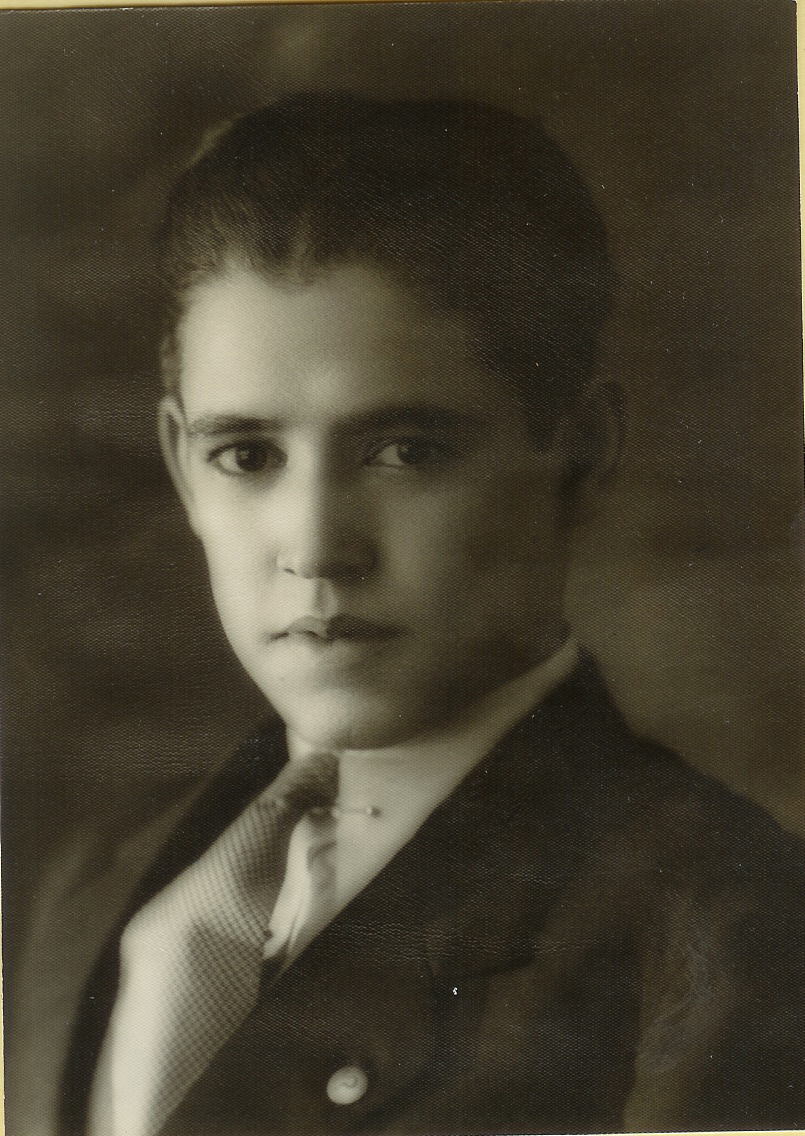
Do you know this soldier?


This photograph of an unidentified young
soldier was in a frame with a family tree
group, hanging on a wall in my Aunt's
 living room. Is he English?


When my family and I traveled to Mexico City to visit our Huesca family in June 2003, I spotted a large frame on the wall of one of my paternal aunts. The frame contained a pictorial family tree of the Huesca family, lovingly made for her by one of my Huesca Sánchez cousins. 

Most of the photographs on the family tree were of my paternal grandparents, José Gil Alberto Cayetano and Catalina (Perrotin) Huesca, my great-grandmother and great-aunt, Maria (Amaro) Perrotin and Blanca Perrotin, and their 11 children, including my father, Gilbert Huesca, my aunt C., and their brothers and sisters. There were about five other small photographs in the frame that I did not recognize. These pictures were not placed on the family tree, because no one seemed to know who they were.  At the time we looked at the photographs, neither my father nor my aunt were able to identify them.

I immediately asked my aunt, or Tía C. for permission to borrow the frame and make copies of the photographs from behind the glass.  She was happy to loan it to me, and I am eternally grateful to her.  It took some time to find a copy and print shop near our hotel.  Bundling the frame with sweaters, I made my way through the press of pedestrians and headed to the shop, taking care to not bump into anyone on the way. Those who have been in Mexico City know this is no easy task.

The job took over an hour to complete, but it was worth the effort.  Most of the copies turned out well, considering the photographs themselves were still under glass.  This one, however, turned out a bit fuzzy, and it is hard to make out the name and location of the photographer on the bottom.

I cannot be sure, but I wonder if it is a portrait of Charles Bennett, son of Timothy and Maria Dolores (Perrotin) Bennett, of Ruardean, Gloucestershire, England.

If you can identify this handsome young man or have any thoughts on possible clues, let me know, and I will share the information in a later post.


**********

Copyright ©  2013  Linda Huesca Tully

Are you a member of the Bennett, Huesca, or Perrotin families, or do you know the identity of this young man?  Share your memories and comments below.

Sunday, March 10, 2013

Sentimental Sunday: Family Treasures


When we moved from Mexico City to California in the spring of 1967, what I dreaded most was being far from our extended Huesca family. 


Cause for Celebration:  Our family got together for holidays but also birthdays, 
anniversaries, and other special occasions, such as this one, taken between 1956 - 57. 
 My mother wrote the names on the photo above.  My grandmother, Catalina
(Perrotin) Huesca, is in the dark dress with the lace collar, next to her mother,
Maria (Amaro) Perrotin.


Back in those days, our life in Mexico was centered on family, rather than on activities. In our family, my grandmother or Abuelita, Catalina (Perrotin) Huesca, was the matriarch, and she held court on the usual family days: Christmas, Three Kings Day, Mother's Day, and her birthday, May 31st. Aside from that, everyone was welcome to come to Sunday afternoon dinner at her home on Carpio Street, where despite the postage-stamp size of her kitchen, there was always a multi-course meal with plenty of food to go around.

My great-grandmother, Maria (Amaro) Perrotin, who was in her late 90s, could either be found at Abuelita's house or at her own home next door.  There, she would line up a row of tiny children's wooden rush chairs gaily painted in bright colors.  Once we children were seated, she would sit on a tiny chair, too, facing us right at our level. She had been shrinking for many years due to her advanced age and fit quite nicely in the miniature chairs. In fact, I was already taller than she was. Her small stature and her fragility appealed to us and made us feel rather protective of her.  We had no idea that for all her delicateness, she had outlived three husbands and four children and raised her two daughters mostly on her own through some of the most trying periods of Mexican history.

My father was the third of eleven children born in the state of Veracruz, on Mexico's eastern seaboard, to Catalina (Perrotin) and Cayetano Huesca. As all of them lived in the Federal District by the 1960s (except for my uncle Carlos, who had moved to Chicago, Illinois), that meant that most of the time we had the pleasure of being around one or more of our 18 uncles and aunts and over 40 first cousins, not to mention my grandmother, great-grandmother, and great-aunt and a number of other relatives.

As all the brothers and sisters had taken an active part in the family hotel and restaurant business in Veracruz, it was only natural that most of them would become entrepreneurs themselves.  Not long before my grandfather, Cayetano Huesca, died in 1937, the family had begun yet another business:  making linens for hotels and restaurants.  

Enrique and Eduardo were the eldest of the remaining 11. Uncle Enrique used to say that to have a successful business, you have to find a need and fill it.  This is probably what the family did - found a dearth of quality custom-made linens and decided to make them themselves.  The whole family worked together - a given for such large family.  Enrique managed the business.  My father and Eduardo traveled around the country selling and distributing the linens.The younger siblings did their part, too, often hurrying home from school to work on the sewing machines and irons or fold the finished products.  

As the children grew up and started lives and families of their own, Enrique and Eduardo each opened their own linen embroidery businesses.  My grandfather Cayetano's brother, Jesús Huesca, helped Enrique in his business. Slightly bent, he was a quiet, gentle man who dressed in light khaki shirts with bolo ties and matching slacks and wore a straw hat.  By the time we met him, he must have been in his late seventies.  He was always glad to see us and after a big hug, he would take us by the hand and lead us through the factory, pointing out the latest embroidery designs or letting us run our fingers over finished tablecloths.  

Enrique and my father were nine years apart, but they could have been twins for all their similarities.  They thought alike, dressed alike, and had the same mannerisms.  They finished each other's sentences, even years after we had moved from Mexico City.  He and my Aunt Meche had four sons, while my parents had four daughters.

Uncle Enrique and my father used to take our families together on Sunday drives into the country, where we would have picnics, go horseback riding, and go swimming.  Health conscious since his youth, Enrique walked and exercised several miles every day, did not smoke, and ate sensibly, way into his old age.  He loved books and music and was very spiritual, often discussing God and morality with us.  Sometimes during our visits he would have me read the front section of the newspaper and discuss the day's stories, to improve my Spanish language comprehension and pronunciation.  I loved being around him and my aunt and their sons, who were like big brothers to me.

Eduardo's business was on Carpio Street, just a couple of blocks from my grandmother's house and across the street from the famous Alameda Park. My great aunt Blanca Perrotin, who was my grandmother's younger maiden sister, used to help Uncle Eduardo in his business, embroidering beautiful floral designs on table linens, aprons, and sheets.  She liked to stay busy and worked with him well into her eighties.

Uncle Eduardo visited my grandmother daily and years later moved in with her.  He was either divorced or separated by then.  For this reason, I never had the pleasure of meeting his children (I think he had a son and a daughter), something I regret.  My sisters and I might have reminded him of them, because he always talked about them when he was around us.  He was a philosopher at heart and loved discussing life and politics with anyone who would listen.  Tia Blanca usually sat at my grandmother's dining room table, recalling family stories and poring over old photographs.  It was hard to get anything past her; she had excellent hearing and a mind like a steel trap, and she could be quick to correct a detail from a conversation going on in the next room and go right back to what she was doing without skipping a beat.  

She was always bringing out boxes and albums of family photographs and knew the stories behind all of them. How I wish I knew what happened to those treasures! Some of those photographs were of our English cousins, the Bennetts.  They were cousins of my grandmother and Blanca's who lived in England and, according to Tia Blanca, had perished during the Second World War.  Happily, this was one of the few times my aunt was mistaken; decades later my husband and I would visit some of the Bennetts in England, where they were very much alive.

My Uncle Mario usually brought flowers or some sweet treat when he came to dinner on his breaks from his job as a trolley driver.  His blue uniform and cap complemented his handsome red hair and blue eyes, which were always twinkling.  A bachelor at that time, he used to joke to my parents that he wanted to marry a gringa -  an American - like my mother.  He was quite a people-watcher and always had a funny story to tell about his passengers.  It is hard to imagine him without a broad smile on his face.  

My father's youngest brother, now in his seventies, was a young man back then, fresh out of university, newly married, and beginning what would become a successful career in communications.  Though he had been only a baby when his father died, he inherited Cayetano's business acumen and passion for his family.  I remember my parents marveling at his energy, vision, and generosity.  He has not changed and continues to look out lovingly for both his immediate and extended family with an enormous heart of gold.

My father always said his sisters were some of the most beautiful women in Veracruz state.  Those were the words of a loving brother, to be sure, but there was no question that they were beautiful, outside and in.  They became the sisters my mother never had and showered my sisters and me with attention, hugs, and kisses.

Victoria, the oldest, had been a beauty queen in Orizaba.  Her nickname was Bella, or Beauty.  She was petite and delicate and like two of her brothers, had gorgeous natural red hair and blue eyes.  She was a widow and worked hard to support her two daughters with a small sandwich shop she ran from her home.  We often went to visit her and played a Mexican version of Ring Around the Rosy or card  games with her younger daughter.

I do not remember visiting my aunt Lucia much, probably because she lived quite far from us, though in the same city, and her children were much older than we were.  I wish I had known her better.  I seem to remember hearing that she had been ill quite a bit.  This may be why she did not come over, but everyone loved her.

Aunt Delia Domitila lived near La Villa, or the neighborhood famous for the location of the Basilica of Our Lady of Guadalupe.  When we were not at her apartment and playing with her youngest son, she was at our house or my grandmother's, showing us her latest crafts. She was such a creative lady, always crocheting doilies and making dolls and gifts for others. She also was a smart dresser and an excellent cook.  Always the life of the party, her nickname was La Periquita - the parakeet - partly because she loved to talk and partly because her voice was so musical. It could be hard to get a word in edgewise sometimes when she got excited about something, but she was so much fun that no one seemed to mind.  She was always showing us photos of her children and in later years was extremely proud that all had become distinguished professionals.

My two youngest aunts, who are in their eighties now, married performers who played in the Jarocho group of Andrés Huesca y Sus Costeños.  Andrés was my father's cousin, known worldwide for his traditional harp playing, coupled with the traditional music of Veracruz state.  Ricardo Díaz and Rodolfo Ruvalcaba, who played guitar and sang with him, were handsome and talented and funny.  

When we visited the Ruvalcabas, my sisters and I would disappear to the TV room with our four cousins to watch episodes (subtitled in Spanish) of The Flintstones cartoons or The Beverly Hillbillies or sing Beatles songs, or play silly games together while our parents laughed downstairs over cocktails. My aunt loved to entertain and was gifted at making everyone feel welcome and happy.  She used to set an elegant table and always played what seemed to me to be very sophisticated music in the background, and Uncle Rodolfo told jokes at the bar while he made drinks for the adults and poured Cokes for the kids. They were so kind and loving to us that I never wanted to go home.

We lived next door to my father's other sister (named for her mother) and my Uncle Ricardo.  To this day, my aunt still has the most expressively beautiful dark eyes and wavy hair. She was so youthful that when her three daughters became teenagers, people used to mistake her for their sister. She was extremely close to my grandmother and devoted herself to caring for her and her own family.  She and my mother shared many a morning cup of coffee together, talking about their daughters and their hopes and dreams for the future. She tried to teach my mother to cook Mexican food, and my mother taught her to make spaghetti and meatballs.  

Living next door to the Díazes meant we got to play with our cousins daily. We created so many memories, bonding over paper dolls and Chinese Checkers and spying on our parents together.  We became more like sisters than cousins, and I remember laughing with one of them because we looked so much alike.  We still talk frequently, and I cannot imagine what my life would be without them.

I am so grateful to my parents for giving us this marvelous opportunity to know our relatives.  Thanks to their foresight, our closeness with our Huesca relatives has grown stronger over the years as we have forged many memories together.  My children stay in touch regularly with their second cousins now and delight in being Facebook friends and talking to them on Skype. Like their parents, they cannot get over how similar they all look and sound and how much they have in common, even though they live thousands of miles away.  That is the wonderful thing about family - our love and shared history connects us through a lifetime, through generations.

When I was young, I was afraid that when we moved to California we would be too far away from our extended Huesca family in Mexico. As I write this, nearly 50 years later, I am happy to say we are closer than ever.


Copyright ©  2013  Linda Huesca Tully

Did you know, or are you a member of the Huesca, Perrotin, Díaz, or Ruvalcaba families?  If so, share your memories and comments below.


Thursday, February 07, 2013

Those Places Thursday: Abuelita's World


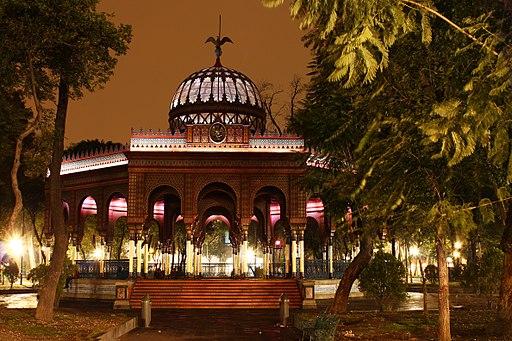
Moorish Kiosk, The Alameda Park, Mexico City. By Ulisesmorales (Own work) [CC-BY-SA-3.0
(http://creativecommons.org/licenses/by-sa/3.0)], via Wikimedia Commons

My grandmother, Catalina (Perrotin) Huesca, lived in a small one bedroom flat at 145-B Carpio Street, in the Santa Maria la Ribera neighborhood.  The neighborhood, or colonia, was the oldest in the Federal District.  Its centerpiece, just a block from my grandmother's house, was The Alameda Park, a beautiful colonial square block park perfect for family gatherings and lazy Sunday afternoons.  My father, Gilbert Cayetano Huesca, taught me to ride a two-wheel bicycle in that park.

In the middle of the park was a stunning, arched Moorish-style kiosk built of colorful tiles laid in intricate geometric designs.  Made of iron from given the engineer by his friend, Andrew Carnegie, the kiosk had been designed as the Mexican Pavilion at the World's Fair from 1884 - 1885 in New Orleans and later at the Saint Louis Fair of 1904 before being dismantled and brought to Mexico City in the early 1900s. On weekends it was often the scene of concerts and other performances.  You can see a panoramic view of the kiosk here.

Abuelita lived in one of two first floor flats in a four unit building on a tree-lined street.  Her living room looked out to the sidewalk. 

As you entered into the house, you passed under a small shelf that hung over the door.  The shelf held a framed picture of Saint Martin de Porres, my grandmother's favorite saint.  You would continue down a long two-tone green hallway that ran the length of the home as you walked down a tile floor of brown and beige octagonal mosaic tiles set in a honeycomb pattern. To your left, you would see each of the other rooms.


My grandmother's bedroom and bathroom were in the center of the house, followed by a tiny kitchen and a dining room at the rear.  All the rooms had windows overlooking the courtyard next door. The courtyard itself led to the home of my Bisabuelita or great-grandmother, Maria (Amaro) Perrotin, and my great aunt, Blanca Perrotin.  Maria was in her late 90s and had survived three husbands; Blanca was a spinster.  They came over every day and stayed past dinner, telling stories around the dining room table.  

About halfway down the hall to the right, you would follow the hallway around an angled turn.  There, the lathe-and-plaster wall ended and a metal half wall began.  It was topped by a long bank of glass block windows.  A metal door opened into a small patio filled with potted geraniums and other flowers and plants whose perfume permeated the air. Abuelita left the door propped open door open all day long to let the fresh air and sunshine into the house.

She also loved to listen to the chirping of her canaries.  Though she had a radio and television in the dining room, the canaries made the real music in the house.  They lived in cages in the hallway between her bedroom and the kitchen.  At any given time they numbered between 6 and 15, all singing their own cheerful songs.  My grandmother said they were singing their prayers to God, because God loved all creatures, especially the small ones. She put them out in her sunny patio when she awoke and brought them in the late afternoon, covering their cages with an old towel so they would quiet down for the night.  

My grandmother's home (to the right) at 145-B Manuel
Carpio Street, in Mexico City.  Courtesy Google Street Maps.
I recall asking whether they had names, and she said no, but she knew which one was which, anyway.  After counting them, I announced that she had as many canaries as she had children, so we should name each of them after my father and his 10 brothers and sisters.  She threw her head back and laughed heartily, rubbing my head.  "Go ahead, then," she said.  We tried that for a while until I realized that unlike my grandmother, I could not tell them apart. Still, I credit her with giving me a love for birds and their sweet songs, especially those colorful canaries, which even to this day, remind of of her and give me reason to smile.

The Spanish language uses a lot of diminutives, and this seemed to apply especially well to my grandmother.  The word Abuelita translates into English as "little grandmother," and she was barely taller than I was.  Everything about her was petite, her hands, her feet, even the tiny wavy curls crowning her head.  She had so many!  I just couldn't figure out how they stayed that way.  I never saw her curl her hair at bedtime, so in my little nine-year-old mind I decided that she must have had to put it up in pin curls and just left them that way for oh, maybe a year or so.  I had not yet heard of permanents.

I think that because she had raised 11 children, she had incredible patience to put up with all of us while we lived with her in that little house.  She never complained but seemed overjoyed to have us, even though it must have meant a lot of extra work.  She was an excellent cook, having learned from her own mother.  She also had been the cook at the hotels and restaurants she and my grandfather, Cayetano Huesca, owned in Tierra Blanca and Perote, Veracruz.  She did not have many pots and pans, but I do remember watching her cook her amazing Mexican-style rice in a cast-iron skillet on a gas stove.

My mother, Joan (Schiavon) Huesca, tried her best to learn how to cook my father's favorite Mexican dishes from Abuelita.  One of these was a breakfast casserole of eggs, chiles, and and tortilla strips, called Chilaquiles.  My mother tried her best to pronounce the word, but it always came out as "Chili-Killies."  After trying to cook it and several other dishes a few times, she gave up and stuck to the Italian dishes she had learned from her own father.  My grandmother did not mind and was happy to let my mother cook from time to time, raving especially about her spaghetti and meatballs. 

Water was - and continues to be - a problem for the residents of the Federal District. Mexico City was built on Lake Texcoco in 1519, and the constant draining of water from the lake and has not only caused the city to sink but also has not been enough for the millions of people who live in one of the largest cities in the world.  Water was severely rationed, and people became expert at conserving it.  Every morning after everyone had bathed, my grandmother cleaned her bathtub and filled it with water so she could use it for cooking, and washing hands and dishes, among other things.  Every day, the city turned the water off in mid-afternoon and turned it back on the next morning.  A couple of times a week, we also experienced power outages, and my grandmother would borrow her votive candles from her room to light the way for all of us.

I think the house was built of lathe and plaster, and like many houses down there, it became cold and humid in the winter.  There was no central heating.  Instead, my grandmother used a tall, portable black kerosene stove to keep warm.  With so many people living there, my parents bought second stove.  They were always very cautious around the stoves, mindful of the many fires there had been from people who had been more careless.

Not long after we arrived, I asked if I could claim the pantry, which had been converted into a broom closet and ironing room, as my bedroom.  My grandmother let me put a cot there, but it stuck out into the hall.  I tried it for much of the day, happy to have a place of my own to retreat to from our noisy family, but I think I gave it up before bedtime when I realized I didn't want to sleep there all alone.  That was the end of "my" room.


Copyright ©  2013  Linda Huesca Tully

Did you know, or are you a member of the Huesca or Perrotin families ?  If so, share your memories and comments below.


Thursday, July 12, 2012

Thankful Thursday: A Father's Influence (Part 2 of 2)


Gilbert Cayetano Huesca
   (1915 - 2009)


My father, Gilbert Huesca,
as a young man.
In Part 1, my father, Gilbert Huesca, described his life as a child growing up as part of a working family in Orizaba, a mountain town in Mexico's eastern state of Veracruz.  In 1923, when Gilbert was 23 years old, my grandfather, Cayetano Huesca, was laid off from his job with the Mexican Railway Company.  He and my grandmother, Catalina (Perrotin) Huesca, moved the family - by now numbering eight children -  back to my father's birthplace of Tierra Blanca (also in Veracruz).  There, they opened another hotel, El Buen Gusto, or the Good Taste Hotel.  Cayetano, ever the entrepreneur, opened a bike rental business for his guests.  The stories below are told in my father's words, taken from our conversations over the years:


"When I got a little older and we moved back to Tierra Blanca, I started riding a bike.  My father wanted all of us to learn how to ride bikes, but again, how could he do that with so many children and so many responsibilities?  He was a father first and a businessman second.  So, what else? - he decided to rent bicycles.

"When he gave one of us a bike, it would be a brand new bike, and he’d show us how to ride it and become familiar with it.  Of course, we’d ride our bikes all around Tierra Blanca.  Going around the Alameda, the main park of the town - and it’s a big park - would be my dad, Enrique, Eduardo, Victoria, and I.  My father used to push us forward.  'We’re gonna fall,' we’d say.  And he’d say, 'Okay. Fall!  We’re gonna learn on the bike.  You have to get back on the bike.'

"And so we learned to be good bike riders.

"Not too long after I got my bike, I fell off and it broke.  I went home to my father, crying because I wanted him to fix it for me.  He took the bike from me and instead of fixing it, he took it apart completely, piece by piece.  'I'm not going to repair your bike,' he said. 'You are going to do it yourself.'

"I couldn't believe it.  I started crying again, this time very loudly.  'But I don't know anything about bikes!  How am I going to fix it if I don't know anything about bikes?'

"My father was a very wise man, and he knew what he was doing.  'Maybe you don't know anything about bikes yet, but this is how you will learn.  And I know you can do it.'  And he just left me there, staring at my bike.

"I sat there for a long time.  I couldn't believe he would leave me like that.  At that moment, I thought he was the meanest father in the world.  I cried and cried.

"And after a while, I realized he was not coming back to help me, and I began to look at the parts.  I picked them up and began turning them over in my hands.  And I put my bike back together again, all by myself.  I was very proud that I could do it.  And when I showed my father, I could see he was very proud of me, too.

"Some time after that, I was out riding my bike and was enjoying the ride so much I did not pay attention to the time.  When I realized how late it was, I rode home as fast as I could.  I could hear my parents looking for me in the hotel, calling my name.  I ran to my room with my bike.  I do not know why I still had my bike with me, but I hid under my bed and pulled my bike under the bed, too.

"My father came to my room, calling my name.  He sounded very angry.  I tried to move farther under the bed, but I guess I pushed my bike out a little bit, and my father saw it.  He knew I was there and told me to come out.  I knew I was in big trouble.  I tried to get out, but I was stuck!  My father had to help me get out of there.  I think he knew that I had suffered enough when I finally got out, because he never punished me.  I learned my lesson and never came home late again.

"My father used to tell us that our parents are right next to God. He did not mean by this that they were equal to God, but that they had a duty that was given them by God to love us and teach us in the same way as He would.  They made many sacrifices for us but never called attention to themselves. My father used to say you should never let the right hand know what the left hand is doing.  They understood that this was their obligation as parents.  Whatever they had, they shared with us and with anyone else who needed help.  And they expected us to do the same.  

"None of us wanted to disappoint our parents, not because we were afraid of them, but because we viewed them in a sacred way.  They never raised a finger to us.  All my father would have to do when he disapproved of something we did was look at us in a certain way, and we would know we had done something wrong.  It was very powerful.  

"The love my mother and father had for us was the best education in life and values we could ever have.  How lucky we were.  Thank God for them."

Copyright ©  2012  Linda Huesca Tully


Did you know, or are you a member of the Huesca or Perrotin families? Did you live in Veracruz in the early to mid-twentieth century?  If so, share your memories and comments below.


Monday, July 09, 2012

Amanuensis Monday: It Came Back to Me in a Dream


Gilbert Cayetano Huesca 
  (1915 - 2009)


[Note:  Amanuensis is an ancient word meaning one who performs the function of writing down or transcribing the words of another.  Derived from the Latin root manu-  , meaning manual or hand, the word also has been used as a synonym for secretary or scribe.]

My father, Gilbert Huesca, August 2008

My father's earliest memory - of the period from 1917 to 1919, when he was between two and four years old - came to him weeks before he died in June 2009, at the age of 93.

"It came back to me in a dream," he told me that Sunday morning in May.  He had been thinking about it for a few days by then.

"For so many years I couldn't remember how I spent my earliest years, and it came back to me in a dream, but it was reality."

He went on to recall that his father, Cayetano Huesca, and a group of other people, including several British and American citizens, were hired on a contract basis in about 1917 to perform maintenance on the machines at a lumber mill in Coapan, a town in the state of Chiapas.  Cayetano brought my grandmother, Catalina (Perrotin) Huesca, his sister-in-law, Blanca Perrotin, his mother-in-law, Maria (Amaro) Perrotin, and their children, Enrique, Eduardo, Victoria, Gilbert (my father), and Delia Domitila.

"There were two classes (on the train) in Mexico:  first class and second class.  We traveled in first class, and we were sent with the very best things.  I remember we arrived in Coapan, close to Tonala.  I was about two or three years old.

"I believe the name of the company at the time was Coapan Lumber Company, belonging to Chiapas state, and the new railroad city was Tonala. (The company) provided a compound of very nice homes for the employees from Orizaba.  We had a large English style home, built of lumber, a very good home."

The homes were built across the street from the lumber mill.  The area was surrounded by a lush forest and fields, where the Huesca family often went on picnics.  Livestock and wildlife were plentiful, so much so that the children were never left unattended while playing outside.

There were a lot of people with English surnames, but my father remembered the names of two men in particular:  a Mr. Wilson and a Mr. McDaniels.   He did not know what they did for the lumber mill, but he did recall that Mr. McDaniels was a close friend of Tia Blanca's.

"And everyone spoke in English, including my mother, my grandmother, my aunt, and us kids. Even my father.  Everyone.  No Spanish at all. . . . Everything was American or English.  My mother was always well-dressed, in a skirt and a little tie."

The most vivid memory he had of the place was the day a massive fire destroyed the mill.  "It was the first fire in my life. We saw the flames. Victoria was there and Enrique was there and Eduardo was there, too.  And I remember the fire came right up to our house, but the house never caught on fire.

"I don’t know -  I guess I was scared, but I was very little, and to me, it was still fascinating.  There were animals like cows and oxen that were pulling little wagons to move things out of the lumberyard, but it was too late.  Big, big flames came and engulfed the lumber company.  It disappeared. It just disappeared."

And so, too, did the contract.  "After that, we weresent back to Orizaba.  But thosetwo years were part of our lives.  Maybe even the best time of our lives.

"It came back to me in a dream after all these years, but it was part of my life."

   * * * * *

My father died of prostate cancer barely a month after he told me this story.  It was the first time and only time I heard it, and the more I think about it, the more questions I have, though none of these have to do with the integrity of the story.  I have every reason to believe my father, especially given his sharp memory for detail, even during his final months.  I recall that he was even quick to remind me that he was not taking any medication that would have affected his recollection.

I cannot find information now about the Coapan Lumber Company, but there is a small village of Coapa in the southern state of Chiapas, with a population of about 100.  

Chiapas, with its dense forests and jungles, definitely has a history of deforestation, particularly since the early 19th century, when foreign interests brought in a number of cattle ranchers and lumber companies, the latter attracted by the Lacandon mahogany, also called "Tabasco Wood." These foreign-run companies began to decline in 1917, and they disappeared altogether in 1949, when the Mexican government prohibited the exportation of log lumber.

With that said, however, remember that my father references the Coapan Lumber Company as owned by the state of Chiapas.  Had it originally been foreign-owned and perhaps nationalized by 1917?  And what of the fire that destroyed the lumber company?  Was it accidental, or could it have been caused by arson, as part of the brewing unrest over foreign exploitation of the land and its people?

My grandfather, Cayetano Huesca, was trained by his father as a carpenter but expanded his skills and abilities to become a mechanic, an invaluable job in the Industrial Age, and one that would serve him well later upon his return to Orizaba, when he became a mechanic on the Mexican Railroad..  It would be easy to see that his skills would have been in demand at a lumber mill.  The fact that he may have also been able to speak English (his wife and her family did, having spoken English and French at home) would have made him more useful to British or American lumbermen.  At the time, Orizaba continued to have an expatriate colony of British, French, and American citizens, most of whom had come to work on the railroad many years before.  Hence, it would make sense that the city would be a good source of skilled workers to augment the (often forced) labor of the Lacandon Indians who worked in the lumber camps and cut down the trees.

I believe this is a valid recollection of an early part of my father's life. Though sadly there is no one left today who can fill in the blanks of this story, I hope we will find those answers some day.


Copyright ©  2012  Linda Huesca Tully


Did you know, or are you a member of the Huesca or Perrotin families?   If so, share your stories and comments below.

Sunday, February 12, 2012

Sentimental Sunday: "Do Not Give In": Part 2


Full Circle

Second in a two-part series - Continued

My great-grandfather, Enrique Huesca (about 1850 - 1920)

Jose Enrique Florentino Huesca, known as "Enrique," lost his wife, Maria de la Luz Merlo, whom he called “mi Lucecita,” or “my little light,” some time before 1912, about three years before the death of his young grandson, Gilberto Huesca.  My father, Gilbert Cayetano Huesca, and his brothers and sisters recalled hearing stories of their grandparents’ unwavering devotion to one another, so it would not be unlikely that Enrique was still grieving for his beloved wife even as he was consoling his daughter-in-law.  Upon reading these tender and feeling words, however, one wonders whether he ever really recovered from the burdens of his own crosses.  He was about 70 years old when he died in Cañada Morelos, Puebla, on August 20, 1920.

Enrique’s son and daughter-in-law, Jose Alberto Gil Cayetano “Cayetano” and Catalina Huesca welcomed a baby son on November 1, 1915, in Tierra Blanca, Veracruz, seven months after the death of their beloved toddler Gilberto.  It is possible that the new baby reminded them of the child they had recently lost, and that may be why they gave him the same first name:  Gilberto. 

Gilberto Cayetano (his middle name was given for his father) Huesca – my father – was called by his middle name, “Cayetano” (or “Tano” for short) by all.  Perhaps his parents decided not to call him by his first name because it might remind them of the tragic loss of the first Gilberto.  This may be the reason my father never learned of his first name until he was in his 40s, when, living in Chicago, Illinois, he obtained his baptismal record for his naturalization application to become an American citizen.  Upon seeing his full name for the first time, he asked his family and friends to call him Gilbert from that day forward.

Enrique Huesca’s words to my grandmother came full circle some 82 years later.  It was 1997, and my father, by then 82 years old, was still mourning the loss of my mother, Joan (Schiavon) Huesca, a decade earlier.  Like his grandparents, he and my mother had been deeply in love, and her absence now permeated every aspect of his being.  He used to tell my sisters and me that he thought of her “every fraction of a second,” and we never doubted this. 

My father was visiting us for dinner one Saturday evening when we called my grandmother Catalina at her apartment in Mexico City.  She was 104 years old but was as sharp as ever and would continue to reign as the respected matriarch of her large family until her death in 1998. 

I turned the speakerphone on so we could hear each other, and after the usual greetings, she asked my father how he was.  My father, in an emotional voice, told her of the profound sadness he still felt without my mother. 
Catalina and her son, Gilbert Cayetano Huesca
Mexico City, about 1948


My grandmother initially expressed her sympathy but then stopped abruptly.  “Hijo mío – my son,” she admonished him in Spanish, “ya basta – that is enough.  Of course you love her and of course you miss her.  But what has happened is done.  You had a beautiful life with my daughter Joan, and she left you four beautiful daughters.  The time of mourning is over.  If I had done that when your father died at such a young age, I would have dishonored his memory and done a disservice to our family.  I still had so much to do, and so do you, my son.  You must not give in to the pain, but live for the living.  You must not forget Joan, but it is time for you to live for your children now.”

It would be inaccurate and unfair to say that my father turned his sadness around right after that.  Yet his mother’s heartfelt wisdom reverberated within him in the coming years as he began to live more fully for his children and grandchildren until his own death in 2009 at age 93. 

His brother Gilberto had, in a strange way, given my father his name.  Maybe in another roundabout and mysterious way, the memory of the first Gilberto also gave his younger brother and namesake a renewed lease on life, even in his final years.


Copyright ©  2012  Linda Huesca Tully 


Did you know any of the people in this story, or are you a member of the Perrotin, Huesca, or Schiavon/Schiavone families?  If so, share your memories and comments below.


Saturday, February 11, 2012

Sympathy Saturday: "Do Not Give In": Part 1


Condolences


Cañada Morelos, April 25, 1915

                       
Mrs. Catalina Perroton.
Tierra Blanca

My Dear Friend,

As I send you my greetings together with all the well-deserved attentions to you and your kind family, I want to send you my deepest sympathies on the death of the Child Gilberto, and you must not believe that it was caused by a Cold, but by the bump he had on his head, which sooner or later would have a sad ending.  It happened…there is nothing you can do but have patience.  Now do not give in to the Pain; but Look at this news with some calm, understanding that it is better to grieve over the dead rather than wish  them alive again; as I did, for I have spent my life in tears wishing they were alive.  The conjugal bond offers us flowers and pleasures…but the cross of marriage, offers us a world of woes.  No matter how much a family may possess, all must go through that world of woes…but all you can do is have a big soul, a Heart that neither denies the truth nor gives in to tears but Sees that this is part of life.  Calm, my friend, calm, do not give in and do not carry this burden around with you.  Give my kisses to all the children.  Your friend who esteems you,

Enrique Huesca


At left, the original letter (in Spanish) from Enrique Huesca to 
Catalina (Perrotin) Huesca, 1915


The above is my English translation of a letter that my paternal great-grandfather, Jose Enrique Florentino Huesca, of Cañada Morelos, Puebla, Mexico, wrote to his daughter-in-law – my grandmother, Angela Catalina (nee Perrotin) Huesca, in Tierra Blanca, Veracruz, Mexico, shortly after the death of her young son, Gilberto Huesca. 

Gilberto was about two years old when he died.  The exact cause of death is unclear; many of the civil records of the village of Tierra Blanca from 1915 were burned in a fire, and most of those who might have known the details have gone on to their heavenly reward. 

Maybe he fell or suffered a blow to the head while playing or pulling down some heavy object from above.  Maybe he had a tumor of some sort.  We may never know, but we can only imagine the grief Catalina felt at losing her sweet little boy.  Enrique, as he was known, gently tells his daughter-in-law that she must not believe that her toddler died of a cold and adds that “sooner or later” the lump would have a sad ending.  In what must have been nearly unbearable for Catalina to conceive, he goes on to reassure her that the child’s fate might have been worse had he lived. 

His words today might sound terribly fatalistic, but they came during a trying period in Mexico.  The country was in the throes of a revolution, and Tierra Blanca and surrounding areas not only experienced the heavy casualties of that conflict but also lost many people, young and old, to outbreaks of measles, diptheria, and smallpox. 


It would have been easy for a young 21-year-old mother to “give in to the pain” of losing her child when she was scarcely an adult herself.  But her father-in-law’s words must have given her the strength she needed to go on and care for her husband Cayetano and their three children, Enrique, Eduardo, and Victoria, even as she was in the first trimester of yet another pregnancy.  Like many of the women of her time, Catalina would prove to be strong and resilient.  She and Cayetano would have 17 children in all, 11 of whom survived into adulthood. 

Catalina and Cayetano Huesca and sons (left to right) Gilberto, Eduardo, and Enrique,
in front of their home, Orizaba, 1913.


Enrique’s letter hints at his own trials and tribulations.  We know little about him except that he was born between 1847 and 1850 in Puebla, Mexico, to Jose Calletano de la Trinidad Huesca and Josefa Rodriguez.  A devout Catholic, he followed in the family trade as a carpenter, crafting interior furnishings for the cathedral and churches of Puebla, a city known for having as many churches as there are days in a year.  He taught his children to do good for others but to keep their acts to themselves, often reminding them to “never let the right hand know what the left hand is doing.”  This was a refrain that his children and their children would carry with them all their lives.

Born at the end of Mexico’s civil reform war, Enrique lived through some of the most turbulent eras of his country’s history.  Before he had even reached his teen years, he undoubtedly witnessed the Battle of Puebla between the French and Mexican armies.  He would have rejoiced wildly with his family at the Mexican victory on May 5, 1862, only to be devastated barely a year later when the French regrouped and defeated the Mexicans in a second battle at Puebla and went on to topple and replace the Mexican government with what Napoleon III referred to as his “Mexican Empire.”  He and his parents would have discussed the resurgence of the deposed Mexican president, Benito Juarez, who with the backing of President Abraham Lincoln, reclaimed his government and had the puppet Emperor Maximilian Hapsburg executed by firing squad in 1867. 

The uncertainty of the times and their severe impact on the nation would continue for many years as subsequent regimes rose and fell one after the other, culminating in the Revolution of 1910 and indelibly scarring the psyche of the Mexican people with the ironic realization that the only constancy in their lives was that  - save their faith in God and their love for one another - nothing, including happiness, could either be certain or last forever. 


Next:  Sentimental Sunday - "Do Not Give In" Part Two

Copyright ©  2012  Linda Huesca Tully 


Monday, January 25, 2010

Francisco Perrotin: 1866 - 1899


Francisco Perrotin
1866 - 1899


“The first cases (of yellow fever) in Orizaba were all of persons living in a small radius, close around the railroad station. In the next epidemic they spread out a few hundred yards farther and took in another block of houses a little farther off from the railroad station as a center, and it may be that in course of time they will establish themselves permanently a little farther off from the railroad station. But at any rate that point, at Orizaba, is the highest point where I found the Stegomyia mosquito permanently breeding in the country of Mexico.” 1   


My great-grandfather, Francisco Perrotín (seen here with his wife, Maria Amaro, their son, Francisco, and infant daughter, Catalina), was one of those “first cases.” A mechanic at the railroad station in Orizaba, in Veracruz state, Mexico, he was likely bitten by an infected Stegomyia fasciata mosquito as he worked on one of the engines there. He was pronounced dead at his home on San Cristóbal Street in Orizaba on Saturday, November 11, 1899, at 6:00 p.m., by Dr. Rafael Labardini, the Perrotin (and later Huesca) family physician. He was 32 years old.


A search for answers

The initial outbreak in Orizaba stunned scientists, as the offending species was not native to a city that rose 4,500 feet above sea level. Scientists and medical experts on the disease quickly descended on the area and traced the source of the disease to the mosquitoes breeding in the waste water from the Montezuma brewery, across the street from the railroad station in the port city of Veracruz. Mosquitoes were believed to have been transported inadvertently on the trains to Mexico City and were released when the cars were unloaded at Orizaba, accounting for the first wave of cases at and around that unfortunate station. 2

Yellow fever was the scourge of the late nineteenth century along the east coast of Mexico, the Caribbean, and several port cities in the United States and Central and South America. After a 3 – 6 day incubation period, victims suffered fever, headache, chills, jaundice and vomiting. Most people survived this first stage, while a fifth of those afflicted were doomed to die in misery, experiencing multiple organ failure, internal bleeding, delirium and coma. The vomit, which took on the consistency of coffee grounds (when it was in fact coagulated blood), gave the condition its Mexican name of El Vómito Negro – the Black Vomit. It might as well have been the plague for the terror it wrought in those days.


Although the modern-day world has seen a significant decrease in cases of yellow fever thanks to the wonders of vaccines, there still is no cure for it. Modern-day treatment for the disease includes offering the patient plenty of rest and fluids, blood transfusions for severe bleeding, and dialysis in the event of kidney failure.


From pot-maker to boiler-maker
If Francisco Perrotin’s demise was dramatic, so too, were his beginnings. We can trace the Perrotin family back to Melle, an ancient rural town in the region of Deux-Sevres in western France. It was rumored that his grandfather, Jacques Perrotin, had served with the Napoleonic Army. Francisco's father, Charles Jacques François, however, had refused to perform his obligatory military service and instead left Melle for America with his brother Romain Paul. With enough money for only one ship’s passage, Charles Jacques François smuggled the younger Romain Paul in a mattress onto the “good ship” Louis XIV at Le Havre, France, arriving at New Orleans, Louisiana, on November 29, 1843. Safe from capture for draft evasion, the brothers shortened their names to François and Paul.


The sons of a long line of chaudronniers / poeliers, or oven and pot makers, François and Paul were hard-working, ambitious, and creative. The brothers arrived in America during the last stages of the Industrial Revolution.  They became entrepreneurs, building stoves and ovens and figuring out how to use their metal-working skills in new ways. They made enough money to travel to Cuba, where they stayed for a time, and returned briefly to France to settle the affairs of their newly-deceased father before returning to the United States. In 1860, François married Catherine Grady, a young Irish seamstress who had sailed to America with her own sister some years earlier. The couple lived in Shreveport for a time before moving to New Orleans and later, it was said, to Niagara Falls before heading to Orizaba to make their mark on the flourishing railroad enterprise being promoted between Veracruz and Mexico City.

The Niagara Falls connection
And here is where the mystery of Francisco’s birth begins.

Family legend has it that my great-grandfather, Francisco Perrotin, was born in Niagara Falls, but no one can say for sure. His sister, Maria Dolores, was born on 15 September 1866, in Orizaba, Mexico. If indeed he was born in Niagara Falls, it could have been between 1865 and as late as March 1866, though the later he was born in this period, the more likely it would have been in Orizaba. Maria Dolores could have been born prematurely; hence, it would be possible that Francisco could be born in the same year as his sister and their mother become pregnant right afterwards. If he was born in Orizaba, it probably would have been after the first part of 1867.


Of the five vital records that mention Francisco, four place his birth sometime between 1 April 1865 and 31 May 1867. Only one, his death record, is way out of range. This would be understandable, as the informant, Porfirio Amaro (Francisco’s brother-in-law), would be more likely to have estimated his age.


1.  Marriage between Francisco Perrotin and Maria Amaro
     Date:  3 March 1889
     Age noted on record:    22
     Possible Birthdate Parameters:
     From March 4, 1867 on


2.  Birth Record of Francisco Perrotin, Jr (Francisco's son)
     Date:   31 March 1890
     Age noted on record:   24 
     Possible Birthdate Parameters: 
     Between March 4 and 31, 1867


3.  Death Record of Francois Perrotin
     Date:  26 May 1891
     Age noted on record:   24
     Possible Birthdate Parameters:
     Between 27 May 1866 and 26 May 1867


4.  Birth Record of Catalina Perrotin
     Date:  31 May 1893
     Age noted on record:  26
     Possible Birthdate Parameters: 
     Between March 4 and 31, 1867


5.  Death Record of Francisco Perrotin
     Date:  11 November 1899
     Age noted on record:  29
     Possible Birthdate Parameters: 
     Between 13 November 1869 and 12 November 1870


As the informant for his father, Francois’ death record, Francisco should be a credible source.  However, his age does not line up with the other records. I think it is possible that with all the grief he was going through and all the affairs he had to handle, he forgot that he had just turned 25 and stated erroneously that he was 24.


By removing Francois’ and Francisco’s death records, we narrow down the birthdate parameters and can conclude that Francisco probably was conceived almost immediately after his sister’s birth and would have been born prematurely in Orizaba, between March 4 and 31, 1867.   It also would mean that he was not 29 years old but 32 when he died of the horrendous Yellow Fever, or “Black Vomit” as it was then called, on November 12, 1899.


As for Niagara Falls, could a third child have been born there – perhaps before Maria Dolores and Francisco? Perhaps it was a boy – also named after his father but more likely “Frank” or “Francois.” This would seem plausible. Part of the legend surrounding my great-grandfather was that he was named “Frank” Perrotin. Could there have been a Frank Perrotin who died young, say, before Francisco was born in 1867? This, too, would be reasonable, as Francois and Catherine had some six years from the time of their marriage in 1860 to the time of Maria Dolores’ birth in 1866, to conceive other children during that time, though these conceptions could have resulted in miscarriages, stillborns, or childhood deaths. It still makes sense to think that Catherine and Francois left Louisiana shortly after their marriage, as it would not have been a desirable place to raise a family on the eve of the Civil War. Niagara Falls, by contrast, was home to a number of Frenchmen, refugees from the politics down south.


Though they may have stayed there for a few years and would been closer to Francois’ brother Paul and his own family (who lived in New Jersey at the time?), I think it became apparent at some point that Niagara Falls was not where Francois and Catherine wanted to spend the rest of their lives.


A new venture
Shortly after arriving in Orizaba, Catherine gave birth to two children within a short period of time. María Dolores was born on September 15, 1866, and (following the theory mentioned above) Francisco followed a scant six months later – a surprise if ever there was one. Though premature, the child was buoyed by the high tropical climate, where the air was pure and everything flourished, and he grew into a strong young man who followed in his father’s footsteps as an engine mechanic.  

Thanks to Francois' keen instinct for opportunity, the family was financially comfortable and well-travelled.  Maria Dolores married a British train driver, Timothy Bennett, at a celebrated wedding at the Orizaba train station in 1885, and Francisco married Maria Amaro in 1889.  He was 22; Maria was 18.  The couple welcomed their first-born son, Felix Francisco “Pancho”, a year later. Four other children followed: Juan, Catalina (my grandmother, or Abuelita, who was named for her own Irish grandmother, Catherine), Hugo Ramiro, and Blanca Luz.


The young family lived in a house on the "with the letter 'I' on the second street of San Cristobal" in Orizaba. Francisco and Maria (who presumably was multilingual like her husband) spoke Spanish, French, and English at home, and their children grew up speaking all three languages fluently and gliding easily from one to another, much as their parents had done before them.


François died of meningitis in 1891 at his home on the station property. A year later, Francisco and María’s infant son, Juan died of the same disease while still in his infancy. Shortly afterward, María Dolores and Timothy left for England with their own two young children. The grief of losing her father, coupled with the fear that the dreaded meningitis might affect her own babies, must have shaped María Dolores’ decision to embark on such a major change, although it is also probable that Timothy was ready to return home to his own family and origins.


Catherine, also grieving for her beloved François and missing her daughter, eventually decided to join her and her son-in-law in England. Though she hated to leave her son and grandchildren, Pancho and Catalina, she told herself that Francisco was going to be all right with his young and growing family, while Dolores, in a new land, needed her more. She left for England in 1895.  As she bade Francisco farewell, she may have wondered whether she would live long enough to see him and his family again.  Little did she know that she would outlive her son by two years.   


When Francisco died in 1899, Pancho was 9; Catalina was 6; Hugo was 4; and Blanca Luz (later called Blanca) was a month shy of her first birthday. Juan had died seven years before of meningitis.  

Of the five children, Juan was the shortest-lived, succumbing at the age of nine months, while Catalina (pictured below, left) would live the longest, dying in 1998 at the age of 105.


Pancho grew up to become a mechanic in the new family tradition. He married a woman named Ester, and they had two daughters, Catalina and Celia. He died in 1921 or 1922, probably in Veracruz state. My father, Gilbert Huesca, recalled that his Uncle Pancho had very Irish looks - a stocky build, red hair and fair skin. He also remembered that his Uncle owned a most unusual cast iron stove, untypical of the stoves in Orizaba at the time. Did Pancho build it? Or did his grandfather, Francois, the poelier?


Hugo became the family correspondent with his grandmother Catherine, his Aunt Dolores Bennett and his cousins overseas. When his letters stopped suddenly following a major earthquake in Mexico, the Bennett family assumed that he and all the rest of the Perrotin family in Mexico had been killed in the earthquake. (Contact between the two branches of the family resumed a century later, when Don and Jennie Murray of Highnam, England, contacted me and began correspondence, in June 2006.) Other than this, I do not know whether Hugo ever married or at what ever became of him.

The three Perrotin women had wavy dark brown hair and lively brown eyes, and they possessed an inner strength that was as appealing as their beauty. Blanca Perrotin was about 5’6”, slender, regal, proud, strong-willed, and beautiful. As a young woman, she was the image of her grandmother, Catherine, and perhaps because of this, she felt extremely close to her all her life, though Catherine had left Orizaba three years before Blanca was born. She was married briefly, but when she found out that her husband had a temper and was known to sleep with a dagger strapped to his calf, she either separated from or divorced him immediately and resolved never to marry again. Perhaps because of this and because she never had the family she had wanted, she became rather bitter. Her stern personality was quite a contrast to her sister Catalina’s, who was a happy person and surrounded by a loving husband and 11 children.

Still, Blanca (shown at right), Catalina, and their mother, Maria (Amaro) Perrotin, were very close. Aunt Blanca and her mother lived together all their lives, always next door or very near Catalina, first in Orizaba , Veracruz , and later in Mexico City. Aunt Blanca was the leading authority on the Perrotin family. When I was 9 years old, our family moved from Chicago to Mexico City. My great-aunt Blanca, my Abuelita (grandmother) Catalina, and my mother became fast friends, perhaps because of their shared Irish heritage, and they spent hours poring over family pictures and sharing family stories. Although she did not need to work, Aunt Blanca was an industrious woman and worked with her nephews (my paternal uncles) in their embroidery businesses. She died in about 1980 or so, roughly at about 88 years of age.


María Amaro Perrotin, Francisco’s widow (shown above), would live to age 98. A beautiful and attractive woman, she would marry again, twice in fact, after Francisco’s death, to foreigners; both of whom died of natural causes. She ran a bakery or café in Orizaba, helped by her daughters.  It was there that Catalina met the young Cayetano Huesca, who she would soon marry.

_____________
1  Dr. L.O. Howard, chief of the U.S. Department of Agriculture’s Office of Entomology, reporting on the pattern of the initial outbreak of yellow fever in Orizaba during 1899, Transactions of the Second International Sanitary Convention of the American Republics, The Willard Hotel, Washington, D.C., October 9 – 14, 1905
 
2  Dr. Narciso del Río, one of Mexico’s top experts on yellow fever and a member of the Consejo Superior de Salubridad Pública.  Public Health and Reports, Volume 28, by the American Public Health Association, 1903


Post Script:  Revenge

My husband and I have been sick since last week with nasty colds - it is very damp here in California right now - and we’ve spent a considerable amount of time resting and reading. Last Saturday, I read up on yellow fever (not the best topic to tackle when you’re sick, by the way) and learned a considerable amount about Stegomyia fasciata, the species of mosquito that became infected and went on to spread the disease throughout coastal Mexico and beyond. It must have really made an impression on me, because when I went to bed that night, I had vivid dreams about mosquitoes and yellow fever.


Sometime during the middle of the night, our eldest son tapped on our door to ask where the bug spray was. It seemed that there was what he called a "gi-normous bug” flying around outside our bedroom, on the upstairs landing. Our son tapped again on our door a few minutes later and said he couldn't find the bug spray and was going to leave the bug there.


Now, normally one of us (not me, mind you) would have gotten up at that point to take care of the dreaded intruder, but my husband and I were too sick and too out of it to budge. Still, I knew what was out there and spent the rest of the night in restless sleep, terrified of being bitten by that horrible mosquito and getting West Nile Virus or some other blood-borne disease. Funny how one's mind can take off like that! When I awoke in the morning, I rolled up a nearby magazine, gingerly opened the door, and held my breath as I looked about the landing. There it was, just above the bathroom door.


"Damn you!" I yelled at him as I swatted it violently. I startled myself with my own reaction and then realized I had killed it not just for myself but for Francisco and the family he left behind. Looking at its flat, lifeless form on the magazine, it seemed ironic to think that such a small insect could have inflicted so much misery.


I went back to bed and slept quite well.


Did you know Francisco or Maria (Amaro) Perrotin or their children, or are you a member of the Perrotin, O'Grady, Amaro, or Huesca families?  If so, share your memories and comments below.


.
Related Posts Plugin for WordPress, Blogger...

Popular Posts

Labels

(Huesca) Diaz (1) Abuelita (1) Adele Fay (1) Agnes Evelyn Gaffney (3) Agnes Gaffney (5) Alice (Carlow) Gaffney (1) Alice (McGinnis) Schiavon (40) Alice E. Gaffney (1) Alice McGinnis (2) Amaro (6) Ambrose Fay (1) Amelia Tully (1) Andres Huesca y Sus Costenos (1) Angelina (Ciliberto) Schiavon (7) Anita Parkhurst (1) Anna Liisa Heiska (2) Annie Quinn (1) Anthony Schiavone (1) Arne Schairer (1) Arthur Tully (3) Aune Kangas (1) Aunt Detty (2) Barbara (Bowman) McCormick (1) Baron (1) Benita (McGinnis) McCormick (80) Bennett (3) Bernice Althaus. (1) Bessie Quinn (1) Bing Tully (3) Blanca Perrotin (6) Bridget (Quinn) Gaffney (3) Buddy McCormick (1) Carlos Huesca (5) Catalina (Perrotin) Huesca (12) Catherine Grady (1) Catherine O'Grady (5) Cayetano Huesca (11) Celaya (1) Celia Perrotin (1) Charles Hoppin Tully (2) Charles Huesca (2) Charles Jacques Francois Perrotin (3) Cherry (2) Cid (1) Cora (Terrill) Gaffney (3) Daniel Fay (1) Delfina (Huesca) Yañez (1) Delia Domitila Huesca (2) Delia Gaffney (4) Domitila Huesca (1) Dorothy Fay (1) Edilberto Huesca (1) Edith (Hoag) McGinnis (1) Eduardo Huesca (10) Edward Bennett (1) Edward Gaffney (1) Eileen Kelly (2) Eldon "Ole" Olson (3) Elizabeth (Kane) Gaffney (1) Elizabeth Cain (1) Elizabeth Gaffney (3) Elizabeth Lyle Gaffney (6) Emanuel “Vito” Schiavone (1) Emanuela Sannella (2) Emily Scheurer (1) Enrique Huesca (12) Ernest F.W. Johnson (2) Ester Perrotin (1) Eugene McGinnis (2) Fay (3) Fay Family (1) Fern (Lawton) Waples (6) Fisher (1) Frances (Gaffney) Cherry (5) Francis Eugene McGinnis (4) Francisco Perrotin (5) Francois Perrotin (4) Gaffney (13) Gene Sheebo (1) Gilbert Huesca (38) Gilberto Huesca (3) Grady (1) Haltie Eaton (1) Healey (2) Helen Crannell (1) Helen Keller (1) Hubert Hotchkis (1) Huesca (11) Hugo Perrotin (1) Jack McGinnis (2) James Cherry (2) James Gaffney (2) Jane (McCormick) Olson (21) Jennifer Fisher (2) Joan (Schiavon Huesca) (1) Joan (Schiavon) Huesca (72) John Charles McGinnis (1) John Cherry (4) John Francis Gaffney (1) John Gaffney (2) John Jussi Kangas (1) John Kangas (1) John McGinnis (9) John Moyer (1) John Patrick Gaffney (1) Jose Calletano de la Trenidad Huesca (1) Jose Enrique Florentino Huesca (4) Jose Gil Alberto Cayetano Huesca (3) Joseph Ciliberto (2) Joseph E. Frick (1) Joseph Fay (1) Joseph Marcinkevich (1) Juho Kangas (1) Kangas (1) Katherine Fay (1) Kelly (1) Leo Dowling (1) Leo Schiavone (2) Licenciado Ocampo Alonso (1) Lorenzo Yañez (1) Louis Algarin (1) Lucia Huesca (1) Lucio Diaz Studio (1) Luz Merlo (1) Lyle Gaffney (1) Maggie Gaffney (1) Margaret (Craven) McCormick (1) Margaret Gaffney (1) Maria (Amaro) Perrotin (2) Maria Amaro (3) Maria Amaro Perrotin (1) Maria Angela Catalina (Perrotin) Huesca (1) Maria Angela Catalina Perrotin (5) Maria Dolores (Perrotin) Bennett (2) Maria Dolores Perrotin (3) Maria de la Luz Merlo (2) Mariano Pantaleon Huesca (1) Mario Huesca (2) Mary (Gaffney) McGoorty (1) Mary Elizabeth Gaffney (1) Mary Jane (Gaffney) McGinnis (26) Mary Tinney (1) Matt Oskar Kangas (2) McCormick (4) McCoy (1) McGinnis (6) McGinnis Family (2) McGinnnis (1) McGoorty (1) Mercedes (Formento) Huesca (8) Merlo (3) Monica Fay (1) Murray (1) Nancy (Gaffney) Zoldak (1) Nancy (Goss) Terrill Frick (1) Nancy Petters (1) Nathaniel Ellery Terrill (1) Nicky Schiavone (1) O'Grady (4) Ofelia (Ortega) Vázquez (2) Ogradi (1) Olson (1) Pasquale Schiavone (1) Pat Schiavone (1) Pat Tully (2) Patricia Fay (2) Patrick Cousins (1) Patrick J. McCormick (1) Paul Schiavon (1) Pellervo Kangas (1) Perroten (1) Perrotin (13) Philip "Bud" McCormick (2) Phillip McCormick (33) Phillip “Bud” McCormick (8) Plutarco Elias Calles (1) President John F. Kennedy (1) Quinn (3) Rafael Amaro (1) Ralph Schiavon (20) Ralph Thomas Schiavon (12) Ricardo Diaz (1) Riney (2) Roberto Perrotin (1) Rose (Bruton) Fisher (1) Rose Fyleman (1) Ruth Robertson (2) Ruvalcaba (1) Sannella (3) Sarah Ellen Riney (1) Schiavon (5) Schiavone (2) Shirley Ann Althaus (1) Soledad Cid (1) Susanne (Hurley) Gaffney (1) Suzanne (Olson) Wieland (2) Sylvia Gianorio (1) Terrence Quinn (1) Thomas Charles Gaffney (1) Thomas Cherry (1) Thomas Eugene McGinnis (14) Thomas Gaffney (6) Thomas McGinnis (4) Thomas Schiavon (1) Timothy Bennett (5) Tinney (1) Tom Schiavon (1) Tomasso Schicchitani (1) Tully (6) Victoria (Huesca) (1) Victoria Huesca (1) Vito Schiavone (1) Vivian Tully (1) Welner Bing Tully (2) Welner Clayton Tully (1) Welner Tully (3) Welner Tully; Bing Tully (1) Western Union (1) William Hupertz (1) William McGinnis (1)

Cyndi's List

Cyndi's List Cyndi's List of Genealogy Sites on the Internet

Family History Challenge

Family History Writing Challenge