Showing posts with label Catalina (Perrotin) Huesca. Show all posts

Friday, August 30, 2013

Friday's Faces from the Past


Do you know this soldier?


This photograph of an unidentified young
soldier was in a frame with a family tree
group, hanging on a wall in my Aunt's
 living room. Is he English?


When my family and I traveled to Mexico City to visit our Huesca family in June 2003, I spotted a large frame on the wall of one of my paternal aunts. The frame contained a pictorial family tree of the Huesca family, lovingly made for her by one of my Huesca Sánchez cousins. 

Most of the photographs on the family tree were of my paternal grandparents, José Gil Alberto Cayetano and Catalina (Perrotin) Huesca, my great-grandmother and great-aunt, Maria (Amaro) Perrotin and Blanca Perrotin, and their 11 children, including my father, Gilbert Huesca, my aunt C., and their brothers and sisters. There were about five other small photographs in the frame that I did not recognize. These pictures were not placed on the family tree, because no one seemed to know who they were.  At the time we looked at the photographs, neither my father nor my aunt were able to identify them.

I immediately asked my aunt, or Tía C. for permission to borrow the frame and make copies of the photographs from behind the glass.  She was happy to loan it to me, and I am eternally grateful to her.  It took some time to find a copy and print shop near our hotel.  Bundling the frame with sweaters, I made my way through the press of pedestrians and headed to the shop, taking care to not bump into anyone on the way. Those who have been in Mexico City know this is no easy task.

The job took over an hour to complete, but it was worth the effort.  Most of the copies turned out well, considering the photographs themselves were still under glass.  This one, however, turned out a bit fuzzy, and it is hard to make out the name and location of the photographer on the bottom.

I cannot be sure, but I wonder if it is a portrait of Charles Bennett, son of Timothy and Maria Dolores (Perrotin) Bennett, of Ruardean, Gloucestershire, England.

If you can identify this handsome young man or have any thoughts on possible clues, let me know, and I will share the information in a later post.


**********

Copyright ©  2013  Linda Huesca Tully

Are you a member of the Bennett, Huesca, or Perrotin families, or do you know the identity of this young man?  Share your memories and comments below.

Tuesday, March 12, 2013

Traveling Tuesday: California Here We Come


California Poppy, Flickr Photos,
courtesy Brian

Having packed our 1962 Ford Falcon station wagon to the hilt for the long drive to California, my father, Gilbert Cayetano Huesca, stopped one last time at my grandmother's home so our family could give her one last goodbye kiss.

She was 68 years old by then and had started to shrink in height, like her mother before her.  As we stood eye to eye, each wiping tears from the other's face, I wondered when we would see her again.

Many of our other relatives had come to my grandmother"s home to say their goodbyes to us, too. She had prepared a big send-off for us, much the same as she had when we had arrived just three years earlier.  I remember thinking how lucky we were to have so many people who cared about us.


We set off in the first days of April, just after Easter, and as we made our way north, the world kept turning.  Martin Luther King spoke on April 4th at New York's Riverside Church, denouncing the Vietnam War and exhorting his audience to "break the silence of the night" by speaking out against it. On April 5th, Philadelphia '76er Wilt Chamberlain set an NBA record for a whopping 41 rebounds in a close game (115-104) against the Boston Celtics.  The next day,  French Premier Georges Pompidou formed a new government, called the Third Ministry.  The biggest news of that week, however, occurred April 7, the day we arrived in Northern California, when Israel shot down six Syrian MiGs over the Golan Heights, prompting a major air battle that would lead to the Arab-Israeli War two months later.

As we crossed the border from Tijuana into San Ysidro, California, we noticed a difference right away as wide, modern freeways replaced narrow, tired, and bumpy highways. Cars were larger.  Green freeway signs with raised letters seemed to sparkle in the sunlight.  It felt as though we were gliding along, not driving.


My parents decided to take scenic Highway 1,  also known as the Coast Highway, so we could have our first look at the Pacific Ocean.  My mother, Joan (Schiavon) Huesca, wanted us to never forget the day we arrived in "Sunny California." The dramatic sight of the gleaming waves against the cerulean sky as we crossed Bixby Bridge high over Big Sur will remain in my memory forever.  I fell in love with the sea that day.  


Bixby Bridge, Big Sur, Flickr Photos, courtesy Sequoia Hughes
It was exciting to hear English spoken on the radio again.  My mother had to adjust the stations occasionally as we would drive out of range, so we listened to quite a variety.

One of  the songs that was popular on the airwaves that day was "Happy Together" by the Turtles, at that time the #1 Billboard Song for the third week in a row.  A catchy and upbeat tune, it seemed a fitting background to the excitement we all felt as we marveled at the wonders of our new home state.

It did not take long for my father to find a job working for a sign company in South San Francisco, and he and he and my mother found a small ranch style house to rent on San Bruno Mountain, up a hilly street at Morningside Drive in a neighborhood bearing the cheery name of Sunshine Gardens.   Our side of the street was the last row of houses on what was called Sign Hill, just below large concrete letters that spelled out to the world that this was  "South San Francisco - the Industrial City."

How exciting, we thought, to be in San Francisco at last.  But where were all the cable cars and skyscrapers? Only after a couple of weeks did we learn that South San Francisco, also known as "South City," was not really part of the grand City by the Bay, but was in fact separated from it by San Bruno Mountain.  

My parents enrolled us in the neighborhood public schools.  My sisters attended Sunshine Gardens Elementary School, and I went to Parkway Intermediate School, a short walk from home.  

One day in May, my father took my sisters and me downtown to the hardware and the five-and-dime store.  We saw a sign advertising the city's annual Mother's Day celebration.  We entered our mother in a contest that was part of the celebration and were surprised a few days later when she won Mother of the Year.  

She was, of course, thrilled.  We all went downtown for the parade and cheered loudly as she got to ride down the street in an open air car.  We wanted everyone in town to know she was our mother.  When the parade ended she was awarded her special prizes from the sponsoring shops:  a rubber spatula, a can opener, a ladle, and a mixing bowl!  Definitely the signs of a time that was about to come to an end.  It did not matter that day, though.  My mother was very proud of her honor and grateful to her family for nominating her.  She baked us a chocolate cake that night to celebrate.

There was something else we had not expected.  Being right between the ocean and the San Francisco Bay meant that the marine layer of fog came in every morning, putting a chill in the air that sometimes dropped close to freezing, even in the summer.  We could actually watch as it shrouded our street and slowly crept down Forest View Avenue on its way to the downtown area at the bottom of the hill.  When that happened, the sun disappeared and  you could not see a thing.  Some mornings the fog would burn off by midday, but other days it just lingered there, gray and taunting, as we wondered what had happened to the Sunny California everyone had talked about.

My mother simply could not understand this. So much for "California Dreamin'," the song made so popular a couple of years earlier by the Mamas and the Papas. No one had told her about the fog.  She began to wonder if we had fallen for a myth.   She and my father began looking into sunnier places to live.

Copyright ©  2013  Linda Huesca Tully

Did you know, or are you a member of the Huesca family?  Share your memories and comments below.


Sunday, March 10, 2013

Sentimental Sunday: Family Treasures


When we moved from Mexico City to California in the spring of 1967, what I dreaded most was being far from our extended Huesca family. 


Cause for Celebration:  Our family got together for holidays but also birthdays, 
anniversaries, and other special occasions, such as this one, taken between 1956 - 57. 
 My mother wrote the names on the photo above.  My grandmother, Catalina
(Perrotin) Huesca, is in the dark dress with the lace collar, next to her mother,
Maria (Amaro) Perrotin.


Back in those days, our life in Mexico was centered on family, rather than on activities. In our family, my grandmother or Abuelita, Catalina (Perrotin) Huesca, was the matriarch, and she held court on the usual family days: Christmas, Three Kings Day, Mother's Day, and her birthday, May 31st. Aside from that, everyone was welcome to come to Sunday afternoon dinner at her home on Carpio Street, where despite the postage-stamp size of her kitchen, there was always a multi-course meal with plenty of food to go around.

My great-grandmother, Maria (Amaro) Perrotin, who was in her late 90s, could either be found at Abuelita's house or at her own home next door.  There, she would line up a row of tiny children's wooden rush chairs gaily painted in bright colors.  Once we children were seated, she would sit on a tiny chair, too, facing us right at our level. She had been shrinking for many years due to her advanced age and fit quite nicely in the miniature chairs. In fact, I was already taller than she was. Her small stature and her fragility appealed to us and made us feel rather protective of her.  We had no idea that for all her delicateness, she had outlived three husbands and four children and raised her two daughters mostly on her own through some of the most trying periods of Mexican history.

My father was the third of eleven children born in the state of Veracruz, on Mexico's eastern seaboard, to Catalina (Perrotin) and Cayetano Huesca. As all of them lived in the Federal District by the 1960s (except for my uncle Carlos, who had moved to Chicago, Illinois), that meant that most of the time we had the pleasure of being around one or more of our 18 uncles and aunts and over 40 first cousins, not to mention my grandmother, great-grandmother, and great-aunt and a number of other relatives.

As all the brothers and sisters had taken an active part in the family hotel and restaurant business in Veracruz, it was only natural that most of them would become entrepreneurs themselves.  Not long before my grandfather, Cayetano Huesca, died in 1937, the family had begun yet another business:  making linens for hotels and restaurants.  

Enrique and Eduardo were the eldest of the remaining 11. Uncle Enrique used to say that to have a successful business, you have to find a need and fill it.  This is probably what the family did - found a dearth of quality custom-made linens and decided to make them themselves.  The whole family worked together - a given for such large family.  Enrique managed the business.  My father and Eduardo traveled around the country selling and distributing the linens.The younger siblings did their part, too, often hurrying home from school to work on the sewing machines and irons or fold the finished products.  

As the children grew up and started lives and families of their own, Enrique and Eduardo each opened their own linen embroidery businesses.  My grandfather Cayetano's brother, Jesús Huesca, helped Enrique in his business. Slightly bent, he was a quiet, gentle man who dressed in light khaki shirts with bolo ties and matching slacks and wore a straw hat.  By the time we met him, he must have been in his late seventies.  He was always glad to see us and after a big hug, he would take us by the hand and lead us through the factory, pointing out the latest embroidery designs or letting us run our fingers over finished tablecloths.  

Enrique and my father were nine years apart, but they could have been twins for all their similarities.  They thought alike, dressed alike, and had the same mannerisms.  They finished each other's sentences, even years after we had moved from Mexico City.  He and my Aunt Meche had four sons, while my parents had four daughters.

Uncle Enrique and my father used to take our families together on Sunday drives into the country, where we would have picnics, go horseback riding, and go swimming.  Health conscious since his youth, Enrique walked and exercised several miles every day, did not smoke, and ate sensibly, way into his old age.  He loved books and music and was very spiritual, often discussing God and morality with us.  Sometimes during our visits he would have me read the front section of the newspaper and discuss the day's stories, to improve my Spanish language comprehension and pronunciation.  I loved being around him and my aunt and their sons, who were like big brothers to me.

Eduardo's business was on Carpio Street, just a couple of blocks from my grandmother's house and across the street from the famous Alameda Park. My great aunt Blanca Perrotin, who was my grandmother's younger maiden sister, used to help Uncle Eduardo in his business, embroidering beautiful floral designs on table linens, aprons, and sheets.  She liked to stay busy and worked with him well into her eighties.

Uncle Eduardo visited my grandmother daily and years later moved in with her.  He was either divorced or separated by then.  For this reason, I never had the pleasure of meeting his children (I think he had a son and a daughter), something I regret.  My sisters and I might have reminded him of them, because he always talked about them when he was around us.  He was a philosopher at heart and loved discussing life and politics with anyone who would listen.  Tia Blanca usually sat at my grandmother's dining room table, recalling family stories and poring over old photographs.  It was hard to get anything past her; she had excellent hearing and a mind like a steel trap, and she could be quick to correct a detail from a conversation going on in the next room and go right back to what she was doing without skipping a beat.  

She was always bringing out boxes and albums of family photographs and knew the stories behind all of them. How I wish I knew what happened to those treasures! Some of those photographs were of our English cousins, the Bennetts.  They were cousins of my grandmother and Blanca's who lived in England and, according to Tia Blanca, had perished during the Second World War.  Happily, this was one of the few times my aunt was mistaken; decades later my husband and I would visit some of the Bennetts in England, where they were very much alive.

My Uncle Mario usually brought flowers or some sweet treat when he came to dinner on his breaks from his job as a trolley driver.  His blue uniform and cap complemented his handsome red hair and blue eyes, which were always twinkling.  A bachelor at that time, he used to joke to my parents that he wanted to marry a gringa -  an American - like my mother.  He was quite a people-watcher and always had a funny story to tell about his passengers.  It is hard to imagine him without a broad smile on his face.  

My father's youngest brother, now in his seventies, was a young man back then, fresh out of university, newly married, and beginning what would become a successful career in communications.  Though he had been only a baby when his father died, he inherited Cayetano's business acumen and passion for his family.  I remember my parents marveling at his energy, vision, and generosity.  He has not changed and continues to look out lovingly for both his immediate and extended family with an enormous heart of gold.

My father always said his sisters were some of the most beautiful women in Veracruz state.  Those were the words of a loving brother, to be sure, but there was no question that they were beautiful, outside and in.  They became the sisters my mother never had and showered my sisters and me with attention, hugs, and kisses.

Victoria, the oldest, had been a beauty queen in Orizaba.  Her nickname was Bella, or Beauty.  She was petite and delicate and like two of her brothers, had gorgeous natural red hair and blue eyes.  She was a widow and worked hard to support her two daughters with a small sandwich shop she ran from her home.  We often went to visit her and played a Mexican version of Ring Around the Rosy or card  games with her younger daughter.

I do not remember visiting my aunt Lucia much, probably because she lived quite far from us, though in the same city, and her children were much older than we were.  I wish I had known her better.  I seem to remember hearing that she had been ill quite a bit.  This may be why she did not come over, but everyone loved her.

Aunt Delia Domitila lived near La Villa, or the neighborhood famous for the location of the Basilica of Our Lady of Guadalupe.  When we were not at her apartment and playing with her youngest son, she was at our house or my grandmother's, showing us her latest crafts. She was such a creative lady, always crocheting doilies and making dolls and gifts for others. She also was a smart dresser and an excellent cook.  Always the life of the party, her nickname was La Periquita - the parakeet - partly because she loved to talk and partly because her voice was so musical. It could be hard to get a word in edgewise sometimes when she got excited about something, but she was so much fun that no one seemed to mind.  She was always showing us photos of her children and in later years was extremely proud that all had become distinguished professionals.

My two youngest aunts, who are in their eighties now, married performers who played in the Jarocho group of Andrés Huesca y Sus Costeños.  Andrés was my father's cousin, known worldwide for his traditional harp playing, coupled with the traditional music of Veracruz state.  Ricardo Díaz and Rodolfo Ruvalcaba, who played guitar and sang with him, were handsome and talented and funny.  

When we visited the Ruvalcabas, my sisters and I would disappear to the TV room with our four cousins to watch episodes (subtitled in Spanish) of The Flintstones cartoons or The Beverly Hillbillies or sing Beatles songs, or play silly games together while our parents laughed downstairs over cocktails. My aunt loved to entertain and was gifted at making everyone feel welcome and happy.  She used to set an elegant table and always played what seemed to me to be very sophisticated music in the background, and Uncle Rodolfo told jokes at the bar while he made drinks for the adults and poured Cokes for the kids. They were so kind and loving to us that I never wanted to go home.

We lived next door to my father's other sister (named for her mother) and my Uncle Ricardo.  To this day, my aunt still has the most expressively beautiful dark eyes and wavy hair. She was so youthful that when her three daughters became teenagers, people used to mistake her for their sister. She was extremely close to my grandmother and devoted herself to caring for her and her own family.  She and my mother shared many a morning cup of coffee together, talking about their daughters and their hopes and dreams for the future. She tried to teach my mother to cook Mexican food, and my mother taught her to make spaghetti and meatballs.  

Living next door to the Díazes meant we got to play with our cousins daily. We created so many memories, bonding over paper dolls and Chinese Checkers and spying on our parents together.  We became more like sisters than cousins, and I remember laughing with one of them because we looked so much alike.  We still talk frequently, and I cannot imagine what my life would be without them.

I am so grateful to my parents for giving us this marvelous opportunity to know our relatives.  Thanks to their foresight, our closeness with our Huesca relatives has grown stronger over the years as we have forged many memories together.  My children stay in touch regularly with their second cousins now and delight in being Facebook friends and talking to them on Skype. Like their parents, they cannot get over how similar they all look and sound and how much they have in common, even though they live thousands of miles away.  That is the wonderful thing about family - our love and shared history connects us through a lifetime, through generations.

When I was young, I was afraid that when we moved to California we would be too far away from our extended Huesca family in Mexico. As I write this, nearly 50 years later, I am happy to say we are closer than ever.


Copyright ©  2013  Linda Huesca Tully

Did you know, or are you a member of the Huesca, Perrotin, Díaz, or Ruvalcaba families?  If so, share your memories and comments below.


Monday, February 25, 2013

Motivation Monday: Whatever You Do in this Life Will Come Back to You


Gilbert Cayetano Huesca (1915 - 2009)
Joan (Schiavon) Huesca (1928 - 1987)
José Gil Alberto Cayetano Huesca (1888 - 1937)


Photo by Alex Proimos, courtesy Flickr Creative Commons

"Who is that man?"

The short, stout, hunched over pediatrician my parents had found in the Mexico City phone book and called in desperation to tend to my little sister pointed to a portrait over my parents' bed as he blinked his eyes.

It was late Fall of 1966.  My father, Gilbert Huesca, was a bit startled by this question.  He was more concerned about my seven-year-old sister's illness than about answering questions from a curious man looking at pictures on a wall.  

He redirected the doctor's attention.  "How is our daughter, Doctor Franco?"

The doctor snapped out of his fog.  "Her tonsils and adenoids appear to be inflamed.  How long has she had trouble breathing like this?"

My mother told him that my sister had been sick on and off for a couple of months.  At first it had seemed she was just getting recurrent colds, but when she lost her appetite and began losing weight, it was clear something else was happening.  

The doctor explained that enlarged tonsils and adenoids could cause such symptoms, well as her labored breathing. Why they were enlarged was yet to be determined, but to start with he prescribed a course of antibiotics in case it was a bacterial infection.  If the antibiotics did not work, my sister might need surgery to have her adenoids removed.  In any case, he would see her again in a few days.  

My two other little sisters and I, watching from the door, grimaced.  "Why do they have to add a noise to her?" My baby sister whispered.  "No, silly," I corrected her.  "They're called adenoids. And if they don't get better, then the doctor has has to take them out."  My second sister, always quick to get to the heart of the problem, asked, "So what are adenoids anyway, and are they bad?" I knew as little as she did.  We leaned in closer to get a clue.

My parents, somewhat relieved, thanked the doctor for coming.  "How much do we owe you?" my father asked.  

Dr. Franco seemed not to hear the question but looked back up at the picture.  "I'm sorry, but I have to know, sir.  Do you know that man?"

My father, still puzzled by the doctor's distraction, answered.  "He was my father."

"Your father!  And your name again, sir?"  

"Gilbert Cayetano Huesca."

"My God," the man said emotionally.  "You don't owe me anything, Mr. Huesca.  I owe you.  Your father was my best friend.  He helped me."

Recalling this encounter many years later, my father remarked, "He felt as though he found something special, something that belonged to him."

It turned out that some forty or so years before, José Felipe Franco had been a struggling young doctor in Orizaba, Veracruz, when he met my grandfather,  José Gil Alberto "Cayetano" Huesca.  At the time, my grandfather worked as a mechanic for the Mexican Railway, Ferrocarriles Mexicanos.  When he found out that the young José often skipped meals to make up for the costs of his fledgling medical practice, my grandfather took it upon himself to feed his new acquaintance as if he were one of the family, helped him with business expenses, and recommended him to relatives and friends.  

Over time, Doctor Franco became successful.  He eventually moved to the capital, where he founded a children's hospital, the Clínica Infantil Doctor Franco, on San Cosme Avenue, in the San Rafael neighborhood, or colonia.  He never forgot his humble beginnings and set aside one day a week to care for the poor and indigent, free of charge.  

Of all the ways to meet an old family friend, so many miles and so many years later, this was quite remarkable.   Though Dr. Franco was saddened to know my grandfather had died in 1937, he was glad to learn my grandmother, Catalina (Perrotin) Huesca was now living in Mexico City. He visited her soon afterward and also connected with some of my aunts and uncles. 

The friendship he had shared with my grandfather years before took on a new life with my father's generation of the Huesca family.  I think my father saw a bit of his own father in this grandfatherly gentleman.  Dr. Franco welcomed the connection.  He became quite close to my father and mother and some of my uncles.  They looked out for each other and each other's families over the years, each at his happiest when he could do something for the other.  For the second time in his life, he became a part of our family.   But this time, his story also became part of our family story.   It also led to one of my father's favorite sayings:  Whatever you do in this life will always come back to you.

Dr. Franco continued to treat my sister at his hospital.  He was of the opinion that her enlarged adenoids had been caused by the Federal District's high altitude - 7,000 feet above sea level.  He told my mother and father that he saw two options.  One would be to undergo surgery to remove the adenoids.  The other option would be to move out of Mexico City to another area that was closer to sea level.  This second option, he theorized, might allow her system to regularize itself.

After some consideration of the pros and cons of an adenoidectomy, my parents concluded that moving out of the area might be a safer and more beneficial alternative for my sister in the long run.  Having solved that dilemma, they now had to tackle a new one:  Where should we go?


Copyright ©  2013  Linda Huesca Tully

Did you know, or are you a member of the Huesca or Franco families?  If so, share your memories and comments below.


Saturday, February 09, 2013

Family Recipe Friday: Arroz con Leche (Rice Pudding)


Rice Pudding, also known in Spain and Latin America as
 Arroz con Leche.  Courtesy Wikipedia; in the  public domain.
Having cooked for her family's two hotels in Veracruz state in the 1920s and 30s and for her family of 13 every day for much of her life, my grandmother, Catalina (Perrotin) Huesca, knew how to make anything without a referring to a recipe.

I remember well several dishes she made inimitably:  her frijoles (refried beans), rice; chiles rellenos (stuffed green peppers), sopa de fideos (noodle soup), mole poblano (chicken in mole sauce), and enchiladas suizas (Swiss-style enchiladas in cream sauce).  The frijoles are unlike anything one can get in the United States; the tiny noodles in the sopa always seemed just right for a child to eat; and the chiles rellenos and the mole poblano are the dishes I tend to order when I want to test the authenticity of  a Mexican restaurant. 

Unlike my abuelita, I have to resort to a cookbook for most of the dishes I want to make.  The recipes are good, but truth be told, my results are nothing like hers.

Abuelita also made a delicious cinnamon rice pudding - arroz con leche. Some time after we had moved into a house of our own in Mexico City, our whole family - my parents and all four of us girls - came down with some awful virus that had the six of us bedridden for several days. My grandmother came to the rescue with her rice pudding. It tasted heavenly.  She said it would help us feel better, and she was right. 

I wish I had my grandmother's exact recipe for rice pudding.  This is about as close as I have been able to come after all these years.  

Buen provecho!


Rice Pudding (Arroz con leche)


2 c. whole milk
1 c. medium grain rice
2 cinnamon sticks
1 cup sugar
1 can sweetened condensed milk
1 tbsp. vanilla 

Bring whole milk and cinnamon to boil and add rice.  Simmer for 20 minutes or until milk is nearly completely absorbed, stirring frequently to keep rice from sticking to the bottom of the pot. 

Add sugar and sweetened condensed milk and reduce heat to medium low.  Add vanilla and cook for about three more minutes.  Remove from heat and add raisins, stirring to help them soften.  Sprinkle cinnamon on top before serving.


Copyright ©  2013  Linda Huesca Tully

Did you know, or are you a member of the Perrotin or Huesca families?  Do you remember a special family recipe?  If so, share your memories and comments below.

Thursday, February 07, 2013

Those Places Thursday: Abuelita's World


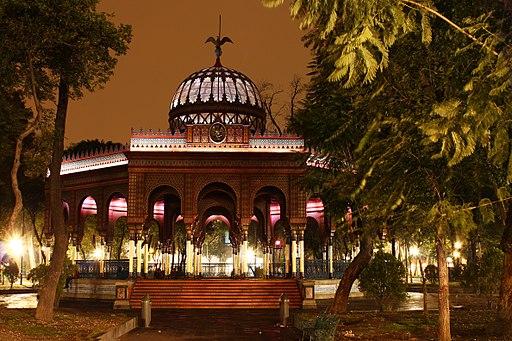
Moorish Kiosk, The Alameda Park, Mexico City. By Ulisesmorales (Own work) [CC-BY-SA-3.0
(http://creativecommons.org/licenses/by-sa/3.0)], via Wikimedia Commons

My grandmother, Catalina (Perrotin) Huesca, lived in a small one bedroom flat at 145-B Carpio Street, in the Santa Maria la Ribera neighborhood.  The neighborhood, or colonia, was the oldest in the Federal District.  Its centerpiece, just a block from my grandmother's house, was The Alameda Park, a beautiful colonial square block park perfect for family gatherings and lazy Sunday afternoons.  My father, Gilbert Cayetano Huesca, taught me to ride a two-wheel bicycle in that park.

In the middle of the park was a stunning, arched Moorish-style kiosk built of colorful tiles laid in intricate geometric designs.  Made of iron from given the engineer by his friend, Andrew Carnegie, the kiosk had been designed as the Mexican Pavilion at the World's Fair from 1884 - 1885 in New Orleans and later at the Saint Louis Fair of 1904 before being dismantled and brought to Mexico City in the early 1900s. On weekends it was often the scene of concerts and other performances.  You can see a panoramic view of the kiosk here.

Abuelita lived in one of two first floor flats in a four unit building on a tree-lined street.  Her living room looked out to the sidewalk. 

As you entered into the house, you passed under a small shelf that hung over the door.  The shelf held a framed picture of Saint Martin de Porres, my grandmother's favorite saint.  You would continue down a long two-tone green hallway that ran the length of the home as you walked down a tile floor of brown and beige octagonal mosaic tiles set in a honeycomb pattern. To your left, you would see each of the other rooms.


My grandmother's bedroom and bathroom were in the center of the house, followed by a tiny kitchen and a dining room at the rear.  All the rooms had windows overlooking the courtyard next door. The courtyard itself led to the home of my Bisabuelita or great-grandmother, Maria (Amaro) Perrotin, and my great aunt, Blanca Perrotin.  Maria was in her late 90s and had survived three husbands; Blanca was a spinster.  They came over every day and stayed past dinner, telling stories around the dining room table.  

About halfway down the hall to the right, you would follow the hallway around an angled turn.  There, the lathe-and-plaster wall ended and a metal half wall began.  It was topped by a long bank of glass block windows.  A metal door opened into a small patio filled with potted geraniums and other flowers and plants whose perfume permeated the air. Abuelita left the door propped open door open all day long to let the fresh air and sunshine into the house.

She also loved to listen to the chirping of her canaries.  Though she had a radio and television in the dining room, the canaries made the real music in the house.  They lived in cages in the hallway between her bedroom and the kitchen.  At any given time they numbered between 6 and 15, all singing their own cheerful songs.  My grandmother said they were singing their prayers to God, because God loved all creatures, especially the small ones. She put them out in her sunny patio when she awoke and brought them in the late afternoon, covering their cages with an old towel so they would quiet down for the night.  

My grandmother's home (to the right) at 145-B Manuel
Carpio Street, in Mexico City.  Courtesy Google Street Maps.
I recall asking whether they had names, and she said no, but she knew which one was which, anyway.  After counting them, I announced that she had as many canaries as she had children, so we should name each of them after my father and his 10 brothers and sisters.  She threw her head back and laughed heartily, rubbing my head.  "Go ahead, then," she said.  We tried that for a while until I realized that unlike my grandmother, I could not tell them apart. Still, I credit her with giving me a love for birds and their sweet songs, especially those colorful canaries, which even to this day, remind of of her and give me reason to smile.

The Spanish language uses a lot of diminutives, and this seemed to apply especially well to my grandmother.  The word Abuelita translates into English as "little grandmother," and she was barely taller than I was.  Everything about her was petite, her hands, her feet, even the tiny wavy curls crowning her head.  She had so many!  I just couldn't figure out how they stayed that way.  I never saw her curl her hair at bedtime, so in my little nine-year-old mind I decided that she must have had to put it up in pin curls and just left them that way for oh, maybe a year or so.  I had not yet heard of permanents.

I think that because she had raised 11 children, she had incredible patience to put up with all of us while we lived with her in that little house.  She never complained but seemed overjoyed to have us, even though it must have meant a lot of extra work.  She was an excellent cook, having learned from her own mother.  She also had been the cook at the hotels and restaurants she and my grandfather, Cayetano Huesca, owned in Tierra Blanca and Perote, Veracruz.  She did not have many pots and pans, but I do remember watching her cook her amazing Mexican-style rice in a cast-iron skillet on a gas stove.

My mother, Joan (Schiavon) Huesca, tried her best to learn how to cook my father's favorite Mexican dishes from Abuelita.  One of these was a breakfast casserole of eggs, chiles, and and tortilla strips, called Chilaquiles.  My mother tried her best to pronounce the word, but it always came out as "Chili-Killies."  After trying to cook it and several other dishes a few times, she gave up and stuck to the Italian dishes she had learned from her own father.  My grandmother did not mind and was happy to let my mother cook from time to time, raving especially about her spaghetti and meatballs. 

Water was - and continues to be - a problem for the residents of the Federal District. Mexico City was built on Lake Texcoco in 1519, and the constant draining of water from the lake and has not only caused the city to sink but also has not been enough for the millions of people who live in one of the largest cities in the world.  Water was severely rationed, and people became expert at conserving it.  Every morning after everyone had bathed, my grandmother cleaned her bathtub and filled it with water so she could use it for cooking, and washing hands and dishes, among other things.  Every day, the city turned the water off in mid-afternoon and turned it back on the next morning.  A couple of times a week, we also experienced power outages, and my grandmother would borrow her votive candles from her room to light the way for all of us.

I think the house was built of lathe and plaster, and like many houses down there, it became cold and humid in the winter.  There was no central heating.  Instead, my grandmother used a tall, portable black kerosene stove to keep warm.  With so many people living there, my parents bought second stove.  They were always very cautious around the stoves, mindful of the many fires there had been from people who had been more careless.

Not long after we arrived, I asked if I could claim the pantry, which had been converted into a broom closet and ironing room, as my bedroom.  My grandmother let me put a cot there, but it stuck out into the hall.  I tried it for much of the day, happy to have a place of my own to retreat to from our noisy family, but I think I gave it up before bedtime when I realized I didn't want to sleep there all alone.  That was the end of "my" room.


Copyright ©  2013  Linda Huesca Tully

Did you know, or are you a member of the Huesca or Perrotin families ?  If so, share your memories and comments below.


Wednesday, February 06, 2013

Wisdom Wednesday: A Grandmother's Love


Catalina (Perrotin) Huesca (1893 - 1998)


"Grandmas hold our tiny hands for just a little while, but our hearts forever."   - Author unknown


My grandmother, Catalina (Perrotin) Huesca,
Chicago, about 64 years old, 1956.
One of my earliest - and warmest - memories of living with my grandmother, or Abuelita Catalina (Perrotin) Huesca was our first night in her home, as she said her bedtime prayers.

We had moved to Mexico City in early 1964, and we stayed with her at her home for a couple of months while my parents, Gilbert and Joan (Schiavon) Huesca, looked for a suitable home.

Despite her limited space, Abuelita made us feel welcome and right at home.  Her English was no longer what it had been when she spoke it at home with her parents, Francisco and Maria (Amaro) Perrotin, but she still understood it fairly well. She hugged and kissed us tenderly and laughed along with us as we sat in her tiny painted wooden chairs.  

We could not have been happier to have so much attention.   I think we somehow figured out in our own childish way that a grandmother's love knows no language barriers. 

My parents and my two youngest sisters slept in the living room.  I thought my other sister and I were the lucky ones when we found out we would get to sleep with our grandmother in her large, soft bed.  

She was deeply religious. Wrapped in her black rebozo, or shawl over a soft flannel nightgown and wearing thick dark socks to keep her legs and feet warm, she tucked us gently into bed, turned off the main light, and lit a couple of candles in tall red glass jars covered with images of the Sacred Heart and Saint Michael the Archangel.    

The candles now being the only light in the room, she knelt at her bedside and recited the Rosary. This was followed by various prayers, first to the Sacred Heart of Jesus, then to Virgin of Guadalupe, and lastly to Saint Martin de Porres, her favorite saint.  Walking purposefully around the room, she stopped at each photograph and reverently lit the votive candles in front of them.  The pictures were beautiful and numerous; they covered all the walls of her room, her two dressers, and the bedside tables. 

She prayed for the people in each of the pictures:  her parents and grandparents, her beloved husband Cayetano, their children and grandchildren, and her beloved sister Blanca Perrotin. She seemed to leave no one out, even though ours was a large extended family.


About 30 - 45 minutes later, Abuelita climbed into bed with us.  I think she was surprised I was still awake, especially after our long journey, but I could not take my eyes off her.  The toasty warmth of the tin heater in the corner, the flickering candles in the room and the dancing shadows on the wall, together with the family pictures and the images of God and all the saints smiling down on us made me feel safe and loved and blessed.  I had never  witnessed anyone talk to God as intimately before this night.  We pulled the covers way up to our foreheads and cuddled together in the soft glow as we fell asleep, my grandmother stroking my head.


Copyright ©  2013  Linda Huesca Tully

Did you know, or are you a member of the Huesca or Perrotin families ?  If so, share your memories and comments below.

Friday, January 11, 2013

Family Recipe Friday: Abuelita's Mexican Rice


María Angela Catalina (Perrotin) Huesca  
(1893 - 1998)


My grandmother or "Abuelita," shown here at her
apartment in about 1983, when she was 90 years old.
She lived independently until her death a month
before her 105th birthday.


I am back to posting after a hiatus of several weeks. It is true that remembering our history and writing about family is what this blog is all about, but after all, being with family - those who are here and a part of our lives now - is what life is all about and gives it meaning.


Another thing that slowed my blogging somewhat was a Christmas gift my husband and I worked on for our family this year.  We have long wanted to compile a family heritage cookbook that would contain the recipes we have collected over the years from our families.  It was an ambitious project that took several months, but it was worth it.   More about that in a future post.


One of the recipes from that book follows here.  My paternal grandmother, or Abuelita, María Angela Catalina (Perrotin) Huesca, was a splendid cook whose dishes were known and loved by not only her own family and friends but also the many guests who stayed at the family hotels, El Buen Gusto (The Good Taste Hotel) in Tierra Blanca, Veracruz; and El Gran Hotel (Grand Hotel) in Perote, Veracruz.

One of my favorite dishes was my grandmother's traditional Mexican rice.  She had many other specialties, but to me, this was one of her signature dishes.  She could never tell me exactly how she made it.  "Ah, hijita (my little one), just a little of this and a pinch of that," she would say whenever I asked her for the recipe.   


Recipes!  Did they really exist before this modern era of cookbooks, cooking classes, and the Food Network? As far as I know, everything in Abuelita's repertoire came from tradition, memory, and experience.  She learned to cook the dishes that had been passed down through the generations.  Her personal touch and the love with which she cooked for her family was what made her meals so memorable.  

Although Abuelita allowed me to observe her make this rice one afternoon, she was rather amused by the idea. Like a modern woman would, I tried to measure the amounts of the ingredients she used and note her techniques. Over the years, I have learned that though the recipe here appears simple, this rice is not easy to master. What you will not find in this recipe is the love that went into it. You will not see the fresh ingredients she had bought from the market that morning or the feel for when something needs "a little more of this or that," is "just enough" or "just right."  That, dear reader, will be up to you.


It would be disingenuous and even presumptuous to say that this was the "definitive" recipe, as the ingredients may have varied from time to time.  However, this is about as close as it came, from my perspective.  When I savor the morsels of chopped carrots and potatoes and freshly shelled peas that give this rice its wonderful texture, I cannot help but see my dear diminutive grandmother blissfully stirring a weathered cast iron skillet atop the gas stove in her tiny kitchen on Carpio Street in Mexico City.

Comfort food, indeed.


Abuelita's Mexican Rice

A traditional accompaniment to many Mexican dishes.

3 cups medium grain rice
1 (1/2) qt. hot water
1/4 cup olive oil
salt to taste
1/2 cup fresh peas
1/4 cup cubed carrots
1/4 medium onion, chopped fine
1 small potato, cubed
1 garlic clove, chopped
1 tomato

Heat oil in pot and add rice when hot.  When rice is yellow and beginning to turn translucent, drain oil, leaving a little to keep rice moist.  Add remaining ingredients and cover.  Cook on low to medium heat until water is absorbed.


Copyright ©  2013  Linda Huesca Tully


Related Posts Plugin for WordPress, Blogger...

Popular Posts

Labels

(Huesca) Diaz (1) Abuelita (1) Adele Fay (1) Agnes Evelyn Gaffney (3) Agnes Gaffney (5) Alice (Carlow) Gaffney (1) Alice (McGinnis) Schiavon (40) Alice E. Gaffney (1) Alice McGinnis (2) Amaro (6) Ambrose Fay (1) Amelia Tully (1) Andres Huesca y Sus Costenos (1) Angelina (Ciliberto) Schiavon (7) Anita Parkhurst (1) Anna Liisa Heiska (2) Annie Quinn (1) Anthony Schiavone (1) Arne Schairer (1) Arthur Tully (3) Aune Kangas (1) Aunt Detty (2) Barbara (Bowman) McCormick (1) Baron (1) Benita (McGinnis) McCormick (80) Bennett (3) Bernice Althaus. (1) Bessie Quinn (1) Bing Tully (3) Blanca Perrotin (6) Bridget (Quinn) Gaffney (3) Buddy McCormick (1) Carlos Huesca (5) Catalina (Perrotin) Huesca (12) Catherine Grady (1) Catherine O'Grady (5) Cayetano Huesca (11) Celaya (1) Celia Perrotin (1) Charles Hoppin Tully (2) Charles Huesca (2) Charles Jacques Francois Perrotin (3) Cherry (2) Cid (1) Cora (Terrill) Gaffney (3) Daniel Fay (1) Delfina (Huesca) Yañez (1) Delia Domitila Huesca (2) Delia Gaffney (4) Domitila Huesca (1) Dorothy Fay (1) Edilberto Huesca (1) Edith (Hoag) McGinnis (1) Eduardo Huesca (10) Edward Bennett (1) Edward Gaffney (1) Eileen Kelly (2) Eldon "Ole" Olson (3) Elizabeth (Kane) Gaffney (1) Elizabeth Cain (1) Elizabeth Gaffney (3) Elizabeth Lyle Gaffney (6) Emanuel “Vito” Schiavone (1) Emanuela Sannella (2) Emily Scheurer (1) Enrique Huesca (12) Ernest F.W. Johnson (2) Ester Perrotin (1) Eugene McGinnis (2) Fay (3) Fay Family (1) Fern (Lawton) Waples (6) Fisher (1) Frances (Gaffney) Cherry (5) Francis Eugene McGinnis (4) Francisco Perrotin (5) Francois Perrotin (4) Gaffney (13) Gene Sheebo (1) Gilbert Huesca (38) Gilberto Huesca (3) Grady (1) Haltie Eaton (1) Healey (2) Helen Crannell (1) Helen Keller (1) Hubert Hotchkis (1) Huesca (11) Hugo Perrotin (1) Jack McGinnis (2) James Cherry (2) James Gaffney (2) Jane (McCormick) Olson (21) Jennifer Fisher (2) Joan (Schiavon Huesca) (1) Joan (Schiavon) Huesca (72) John Charles McGinnis (1) John Cherry (4) John Francis Gaffney (1) John Gaffney (2) John Jussi Kangas (1) John Kangas (1) John McGinnis (9) John Moyer (1) John Patrick Gaffney (1) Jose Calletano de la Trenidad Huesca (1) Jose Enrique Florentino Huesca (4) Jose Gil Alberto Cayetano Huesca (3) Joseph Ciliberto (2) Joseph E. Frick (1) Joseph Fay (1) Joseph Marcinkevich (1) Juho Kangas (1) Kangas (1) Katherine Fay (1) Kelly (1) Leo Dowling (1) Leo Schiavone (2) Licenciado Ocampo Alonso (1) Lorenzo Yañez (1) Louis Algarin (1) Lucia Huesca (1) Lucio Diaz Studio (1) Luz Merlo (1) Lyle Gaffney (1) Maggie Gaffney (1) Margaret (Craven) McCormick (1) Margaret Gaffney (1) Maria (Amaro) Perrotin (2) Maria Amaro (3) Maria Amaro Perrotin (1) Maria Angela Catalina (Perrotin) Huesca (1) Maria Angela Catalina Perrotin (5) Maria Dolores (Perrotin) Bennett (2) Maria Dolores Perrotin (3) Maria de la Luz Merlo (2) Mariano Pantaleon Huesca (1) Mario Huesca (2) Mary (Gaffney) McGoorty (1) Mary Elizabeth Gaffney (1) Mary Jane (Gaffney) McGinnis (26) Mary Tinney (1) Matt Oskar Kangas (2) McCormick (4) McCoy (1) McGinnis (6) McGinnis Family (2) McGinnnis (1) McGoorty (1) Mercedes (Formento) Huesca (8) Merlo (3) Monica Fay (1) Murray (1) Nancy (Gaffney) Zoldak (1) Nancy (Goss) Terrill Frick (1) Nancy Petters (1) Nathaniel Ellery Terrill (1) Nicky Schiavone (1) O'Grady (4) Ofelia (Ortega) Vázquez (2) Ogradi (1) Olson (1) Pasquale Schiavone (1) Pat Schiavone (1) Pat Tully (2) Patricia Fay (2) Patrick Cousins (1) Patrick J. McCormick (1) Paul Schiavon (1) Pellervo Kangas (1) Perroten (1) Perrotin (13) Philip "Bud" McCormick (2) Phillip McCormick (33) Phillip “Bud” McCormick (8) Plutarco Elias Calles (1) President John F. Kennedy (1) Quinn (3) Rafael Amaro (1) Ralph Schiavon (20) Ralph Thomas Schiavon (12) Ricardo Diaz (1) Riney (2) Roberto Perrotin (1) Rose (Bruton) Fisher (1) Rose Fyleman (1) Ruth Robertson (2) Ruvalcaba (1) Sannella (3) Sarah Ellen Riney (1) Schiavon (5) Schiavone (2) Shirley Ann Althaus (1) Soledad Cid (1) Susanne (Hurley) Gaffney (1) Suzanne (Olson) Wieland (2) Sylvia Gianorio (1) Terrence Quinn (1) Thomas Charles Gaffney (1) Thomas Cherry (1) Thomas Eugene McGinnis (14) Thomas Gaffney (6) Thomas McGinnis (4) Thomas Schiavon (1) Timothy Bennett (5) Tinney (1) Tom Schiavon (1) Tomasso Schicchitani (1) Tully (6) Victoria (Huesca) (1) Victoria Huesca (1) Vito Schiavone (1) Vivian Tully (1) Welner Bing Tully (2) Welner Clayton Tully (1) Welner Tully (3) Welner Tully; Bing Tully (1) Western Union (1) William Hupertz (1) William McGinnis (1)

Cyndi's List

Cyndi's List Cyndi's List of Genealogy Sites on the Internet

Family History Challenge

Family History Writing Challenge