Showing posts with label Catalina Perrotin Huesca. Show all posts

Thursday, July 12, 2012

Thankful Thursday: A Father's Influence (Part 2 of 2)


Gilbert Cayetano Huesca
   (1915 - 2009)
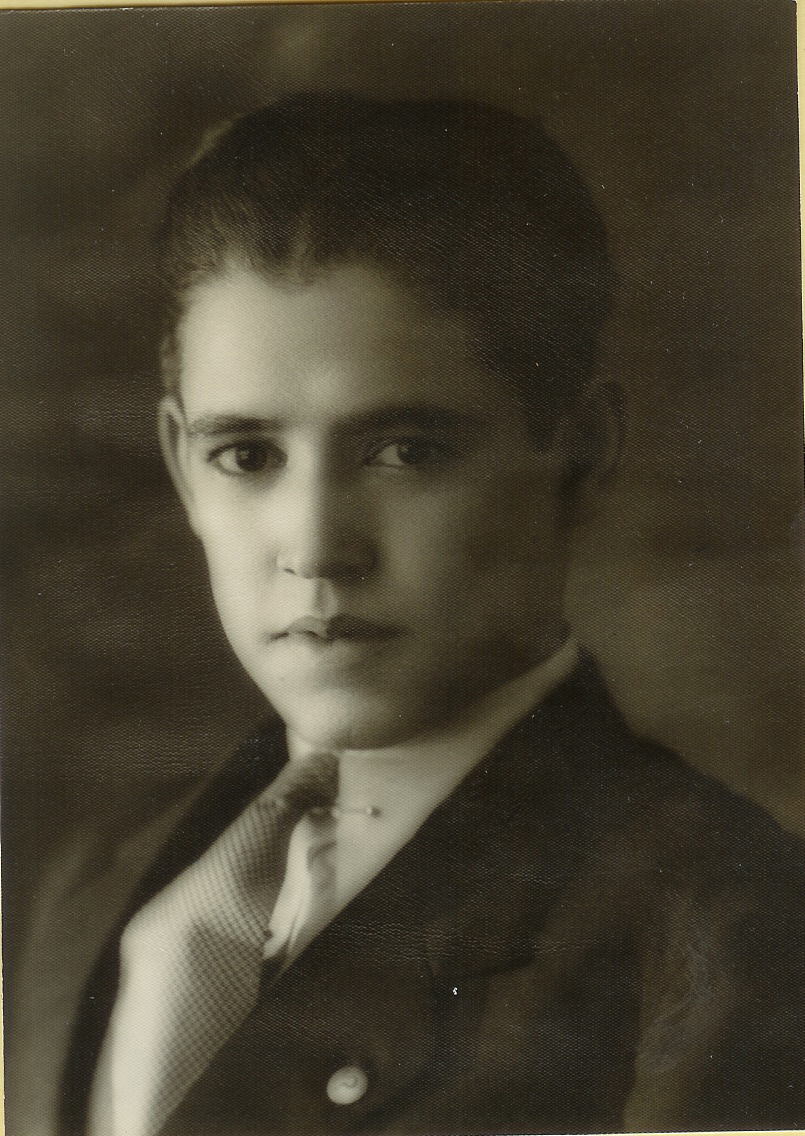

My father, Gilbert Huesca,
as a young man.
In Part 1, my father, Gilbert Huesca, described his life as a child growing up as part of a working family in Orizaba, a mountain town in Mexico's eastern state of Veracruz.  In 1923, when Gilbert was 23 years old, my grandfather, Cayetano Huesca, was laid off from his job with the Mexican Railway Company.  He and my grandmother, Catalina (Perrotin) Huesca, moved the family - by now numbering eight children -  back to my father's birthplace of Tierra Blanca (also in Veracruz).  There, they opened another hotel, El Buen Gusto, or the Good Taste Hotel.  Cayetano, ever the entrepreneur, opened a bike rental business for his guests.  The stories below are told in my father's words, taken from our conversations over the years:


"When I got a little older and we moved back to Tierra Blanca, I started riding a bike.  My father wanted all of us to learn how to ride bikes, but again, how could he do that with so many children and so many responsibilities?  He was a father first and a businessman second.  So, what else? - he decided to rent bicycles.

"When he gave one of us a bike, it would be a brand new bike, and he’d show us how to ride it and become familiar with it.  Of course, we’d ride our bikes all around Tierra Blanca.  Going around the Alameda, the main park of the town - and it’s a big park - would be my dad, Enrique, Eduardo, Victoria, and I.  My father used to push us forward.  'We’re gonna fall,' we’d say.  And he’d say, 'Okay. Fall!  We’re gonna learn on the bike.  You have to get back on the bike.'

"And so we learned to be good bike riders.

"Not too long after I got my bike, I fell off and it broke.  I went home to my father, crying because I wanted him to fix it for me.  He took the bike from me and instead of fixing it, he took it apart completely, piece by piece.  'I'm not going to repair your bike,' he said. 'You are going to do it yourself.'

"I couldn't believe it.  I started crying again, this time very loudly.  'But I don't know anything about bikes!  How am I going to fix it if I don't know anything about bikes?'

"My father was a very wise man, and he knew what he was doing.  'Maybe you don't know anything about bikes yet, but this is how you will learn.  And I know you can do it.'  And he just left me there, staring at my bike.

"I sat there for a long time.  I couldn't believe he would leave me like that.  At that moment, I thought he was the meanest father in the world.  I cried and cried.

"And after a while, I realized he was not coming back to help me, and I began to look at the parts.  I picked them up and began turning them over in my hands.  And I put my bike back together again, all by myself.  I was very proud that I could do it.  And when I showed my father, I could see he was very proud of me, too.

"Some time after that, I was out riding my bike and was enjoying the ride so much I did not pay attention to the time.  When I realized how late it was, I rode home as fast as I could.  I could hear my parents looking for me in the hotel, calling my name.  I ran to my room with my bike.  I do not know why I still had my bike with me, but I hid under my bed and pulled my bike under the bed, too.

"My father came to my room, calling my name.  He sounded very angry.  I tried to move farther under the bed, but I guess I pushed my bike out a little bit, and my father saw it.  He knew I was there and told me to come out.  I knew I was in big trouble.  I tried to get out, but I was stuck!  My father had to help me get out of there.  I think he knew that I had suffered enough when I finally got out, because he never punished me.  I learned my lesson and never came home late again.

"My father used to tell us that our parents are right next to God. He did not mean by this that they were equal to God, but that they had a duty that was given them by God to love us and teach us in the same way as He would.  They made many sacrifices for us but never called attention to themselves. My father used to say you should never let the right hand know what the left hand is doing.  They understood that this was their obligation as parents.  Whatever they had, they shared with us and with anyone else who needed help.  And they expected us to do the same.  

"None of us wanted to disappoint our parents, not because we were afraid of them, but because we viewed them in a sacred way.  They never raised a finger to us.  All my father would have to do when he disapproved of something we did was look at us in a certain way, and we would know we had done something wrong.  It was very powerful.  

"The love my mother and father had for us was the best education in life and values we could ever have.  How lucky we were.  Thank God for them."

Copyright ©  2012  Linda Huesca Tully


Did you know, or are you a member of the Huesca or Perrotin families? Did you live in Veracruz in the early to mid-twentieth century?  If so, share your memories and comments below.


Monday, July 09, 2012

Amanuensis Monday: It Came Back to Me in a Dream


Gilbert Cayetano Huesca 
  (1915 - 2009)


[Note:  Amanuensis is an ancient word meaning one who performs the function of writing down or transcribing the words of another.  Derived from the Latin root manu-  , meaning manual or hand, the word also has been used as a synonym for secretary or scribe.]

My father, Gilbert Huesca, August 2008

My father's earliest memory - of the period from 1917 to 1919, when he was between two and four years old - came to him weeks before he died in June 2009, at the age of 93.

"It came back to me in a dream," he told me that Sunday morning in May.  He had been thinking about it for a few days by then.

"For so many years I couldn't remember how I spent my earliest years, and it came back to me in a dream, but it was reality."

He went on to recall that his father, Cayetano Huesca, and a group of other people, including several British and American citizens, were hired on a contract basis in about 1917 to perform maintenance on the machines at a lumber mill in Coapan, a town in the state of Chiapas.  Cayetano brought my grandmother, Catalina (Perrotin) Huesca, his sister-in-law, Blanca Perrotin, his mother-in-law, Maria (Amaro) Perrotin, and their children, Enrique, Eduardo, Victoria, Gilbert (my father), and Delia Domitila.

"There were two classes (on the train) in Mexico:  first class and second class.  We traveled in first class, and we were sent with the very best things.  I remember we arrived in Coapan, close to Tonala.  I was about two or three years old.

"I believe the name of the company at the time was Coapan Lumber Company, belonging to Chiapas state, and the new railroad city was Tonala. (The company) provided a compound of very nice homes for the employees from Orizaba.  We had a large English style home, built of lumber, a very good home."

The homes were built across the street from the lumber mill.  The area was surrounded by a lush forest and fields, where the Huesca family often went on picnics.  Livestock and wildlife were plentiful, so much so that the children were never left unattended while playing outside.

There were a lot of people with English surnames, but my father remembered the names of two men in particular:  a Mr. Wilson and a Mr. McDaniels.   He did not know what they did for the lumber mill, but he did recall that Mr. McDaniels was a close friend of Tia Blanca's.

"And everyone spoke in English, including my mother, my grandmother, my aunt, and us kids. Even my father.  Everyone.  No Spanish at all. . . . Everything was American or English.  My mother was always well-dressed, in a skirt and a little tie."

The most vivid memory he had of the place was the day a massive fire destroyed the mill.  "It was the first fire in my life. We saw the flames. Victoria was there and Enrique was there and Eduardo was there, too.  And I remember the fire came right up to our house, but the house never caught on fire.

"I don’t know -  I guess I was scared, but I was very little, and to me, it was still fascinating.  There were animals like cows and oxen that were pulling little wagons to move things out of the lumberyard, but it was too late.  Big, big flames came and engulfed the lumber company.  It disappeared. It just disappeared."

And so, too, did the contract.  "After that, we weresent back to Orizaba.  But thosetwo years were part of our lives.  Maybe even the best time of our lives.

"It came back to me in a dream after all these years, but it was part of my life."

   * * * * *

My father died of prostate cancer barely a month after he told me this story.  It was the first time and only time I heard it, and the more I think about it, the more questions I have, though none of these have to do with the integrity of the story.  I have every reason to believe my father, especially given his sharp memory for detail, even during his final months.  I recall that he was even quick to remind me that he was not taking any medication that would have affected his recollection.

I cannot find information now about the Coapan Lumber Company, but there is a small village of Coapa in the southern state of Chiapas, with a population of about 100.  

Chiapas, with its dense forests and jungles, definitely has a history of deforestation, particularly since the early 19th century, when foreign interests brought in a number of cattle ranchers and lumber companies, the latter attracted by the Lacandon mahogany, also called "Tabasco Wood." These foreign-run companies began to decline in 1917, and they disappeared altogether in 1949, when the Mexican government prohibited the exportation of log lumber.

With that said, however, remember that my father references the Coapan Lumber Company as owned by the state of Chiapas.  Had it originally been foreign-owned and perhaps nationalized by 1917?  And what of the fire that destroyed the lumber company?  Was it accidental, or could it have been caused by arson, as part of the brewing unrest over foreign exploitation of the land and its people?

My grandfather, Cayetano Huesca, was trained by his father as a carpenter but expanded his skills and abilities to become a mechanic, an invaluable job in the Industrial Age, and one that would serve him well later upon his return to Orizaba, when he became a mechanic on the Mexican Railroad..  It would be easy to see that his skills would have been in demand at a lumber mill.  The fact that he may have also been able to speak English (his wife and her family did, having spoken English and French at home) would have made him more useful to British or American lumbermen.  At the time, Orizaba continued to have an expatriate colony of British, French, and American citizens, most of whom had come to work on the railroad many years before.  Hence, it would make sense that the city would be a good source of skilled workers to augment the (often forced) labor of the Lacandon Indians who worked in the lumber camps and cut down the trees.

I believe this is a valid recollection of an early part of my father's life. Though sadly there is no one left today who can fill in the blanks of this story, I hope we will find those answers some day.


Copyright ©  2012  Linda Huesca Tully


Did you know, or are you a member of the Huesca or Perrotin families?   If so, share your stories and comments below.

Friday, June 29, 2012

My Father's Early Days in Chicago: 1948


Gilbert Cayetano Huesca (1915 - 2009)


My handsome father, Gilbert Cayetano Huesca,
Chicago, Illinois, about 1948.
Nearly a year after his first visit to Chicago in 1947, the record of Border Crossings:  From Mexico to U.S., 1895 - 1957, of Gilbert Cayetano Huesca's second trip to the U.S., lists him as "Cayetano Huesca y Perrotin.*"  It describes him as 33 years old and measuring five foot six inches, with black hair and brown eyes.   

The record goes on to note that he intends to join "his second cousin, Luis Algarin, 702 W. 61 Place, Chicago, Ill.," and shows he crossed the border on July 14, 1948, with $50 dollars in his possession.   

Although the bond between my father (and our family) and the Algarins and their children remained strong over several decades, I do not recall hearing him mention that they were our cousins.  Were they blood relations?  

A brief foray into the Algarin genealogy does not reveal at first glance a direct connection with the Huesca family, although they might have been connected via the Charles Huesca branch, either as relatives, or friends who felt close enough to think of each other as family.    

The border crossing record continues: ". . . he states that he is now coming to the U.S. as much to study and be with his relatives as to work, and that he can readily find work as a designer.  It appears that he is not excludable as an alien contract laborer."  He returned to  his job at the Metalcraft company as a designer.  He may have been a designer of printed circuit boards, which at the time were designed manually.  He had an eye for detail and precision, traits that were essential for such a job.

The Algarins offered my father a place to stay, which he accepted on the condition that they let him pay for his room and board.  He began taking night courses in English and forced himself to eat out frequently so he would have to practice speaking his new language and would not have to impose too much on his gracious friends.  

He often stopped for dinner at a nearby diner on his way home from work.  Still new at reading English, he had learned how to order an apple pie and a cup of coffee, and this became his usual meal for lack of knowing what else was on the menu!  This went on for several months until the kind waitress at the counter figured out the problem.  My father said that the day she brought him a steak for the first time, he left her a big tip.

_____________

*  Note:  I refer here to my father by his given name: Gilbert Huesca, though at this time he was known as Cayetano Huesca.  To learn the story behind his name, click here.


Copyright ©  2012  Linda Huesca Tully

Did you know Gilbert Huesca, his cousin, Charles, or the Algarin family, or are you a member of one of these families?  If so, share your memories and comments below.


Thursday, June 28, 2012

Those Places Thursday: North to Chicago


Gilbert Cayetano Huesca (1915 - 2009)


My father, Gilbert Huesca, on one of his business trips,
climbing up a Pemex Mexican Petroleum oil tank,
Coatzacoalcos, Veracruz, Mexico
In 1947, Gilbert Huesca was a 32- year-old commercial artist from Mexico City who was eager to see the world and meet new people. 

Before venturing into graphic arts, he had traveled throughout 29 of the 31 Mexican states as a salesman, first for the Huesca family's hotels and casino and later for the family's embroidery business, Sábanas y Manteles Huesca (Huesca Linens and Tablecloths).  

Known at this time as "Cayetano*" to family and friends, he had learned a lot from his entrepreneur father, Jose Alberto Gil Cayetano Huesca, and from his own experiences of working in the family businesses. He felt he was ready to make his own mark on the world when his cousin, Charles Huesca, who was a few years older, invited him to visit his relatives in Chicago.

Encouraged by his family to accept Charles' invitation, Gilbert kissed his widowed mother, Catalina (Perrotin) Huesca and his brothers and sisters goodbye and set out on the long journey north to Chicago.

Charles, his parents, and his sister had moved from eastern Mexico to Chicago in the early 1900s and already had lived there for most of their lives, but they visited their home country often and kept in close contact with their many relatives south of the border, so the reunion between the cousins was an emotional one. 
My grandmother, Catalina Huesca, surrounded by five of
her six sons.  Left to right:  Edilberto, Eduardo, Gilbert,
Mario and Enrique Huesca.  Circa 1946, at my grandmother's
home at 145 Carpio Street, Mexico City


Charles and his family made their cousin feel at home and introduced him to a number of friends, including Louis and Theresa (Mireles) Algarin, who in time would come to consider my father as part of their own family.  He became a frequent guest in their home.

Gilbert fell in love with Chicago - its vibrant sense of progress, its scenic lakefront, and its friendly people. He felt comfortable there and began to consider petitioning for residency, with a view to calling the city his new home.   As his visa allowed him to stay and work in the U.S. for up to 1o months, he decided to stay, and Charles found him a position as a designer for the Metalcraft Corporation on New Orleans Street.  

My father, Gilbert Cayetano Huesca, had this
portrait taken with his mother,  Catalina
 (Perrotin) Huesca, just before he left Mexico 
City  for the United  States in 1948.  He was 
the fourth of her 11 children. 

Just before his visa expired in April 1948, Gilbert returned to Mexico City.  He had several conversations with his mother, whom he respected deeply, about his stay in Chicago and his desire to move there permanently.  Catalina saw the look in his eyes and knew she could not say no to her son.  She reluctantly gave him her blessing and promised to pray for him daily.

Gilbert was elated and began preparing for his return to the States. Shortly before leaving Mexico City, he took Catalina to the Tinoco Photography Studio for a mother and son portrait. Both he and Catalina would treasure their copies for the rest of their lives.  

His new visa arrived fairly quickly, and Gilbert returned to the United States on July 14, 1948, barely two months after he had left Chicago.  


___________________

*  Note:  I refer here to my father by his given name and the name by which I knew him: Gilbert Huesca, though at this time he was known as Cayetano Huesca.  To learn the story behind his name, click here.


Copyright ©  2012  Linda Huesca Tully

Did you know Gilbert Huesca or his family, the Algarins?  Are you a member of the Huesca, Perrotin, or Algarin families?  If so, share your stories and comments below.

Related Posts Plugin for WordPress, Blogger...

Popular Posts

Labels

(Huesca) Diaz (1) Abuelita (1) Adele Fay (1) Agnes Evelyn Gaffney (3) Agnes Gaffney (5) Alice (Carlow) Gaffney (1) Alice (McGinnis) Schiavon (40) Alice E. Gaffney (1) Alice McGinnis (2) Amaro (6) Ambrose Fay (1) Amelia Tully (1) Andres Huesca y Sus Costenos (1) Angelina (Ciliberto) Schiavon (7) Anita Parkhurst (1) Anna Liisa Heiska (2) Annie Quinn (1) Anthony Schiavone (1) Arne Schairer (1) Arthur Tully (3) Aune Kangas (1) Aunt Detty (2) Barbara (Bowman) McCormick (1) Baron (1) Benita (McGinnis) McCormick (80) Bennett (3) Bernice Althaus. (1) Bessie Quinn (1) Bing Tully (3) Blanca Perrotin (6) Bridget (Quinn) Gaffney (3) Buddy McCormick (1) Carlos Huesca (5) Catalina (Perrotin) Huesca (12) Catherine Grady (1) Catherine O'Grady (5) Cayetano Huesca (11) Celaya (1) Celia Perrotin (1) Charles Hoppin Tully (2) Charles Huesca (2) Charles Jacques Francois Perrotin (3) Cherry (2) Cid (1) Cora (Terrill) Gaffney (3) Daniel Fay (1) Delfina (Huesca) Yañez (1) Delia Domitila Huesca (2) Delia Gaffney (4) Domitila Huesca (1) Dorothy Fay (1) Edilberto Huesca (1) Edith (Hoag) McGinnis (1) Eduardo Huesca (10) Edward Bennett (1) Edward Gaffney (1) Eileen Kelly (2) Eldon "Ole" Olson (3) Elizabeth (Kane) Gaffney (1) Elizabeth Cain (1) Elizabeth Gaffney (3) Elizabeth Lyle Gaffney (6) Emanuel “Vito” Schiavone (1) Emanuela Sannella (2) Emily Scheurer (1) Enrique Huesca (12) Ernest F.W. Johnson (2) Ester Perrotin (1) Eugene McGinnis (2) Fay (3) Fay Family (1) Fern (Lawton) Waples (6) Fisher (1) Frances (Gaffney) Cherry (5) Francis Eugene McGinnis (4) Francisco Perrotin (5) Francois Perrotin (4) Gaffney (13) Gene Sheebo (1) Gilbert Huesca (38) Gilberto Huesca (3) Grady (1) Haltie Eaton (1) Healey (2) Helen Crannell (1) Helen Keller (1) Hubert Hotchkis (1) Huesca (11) Hugo Perrotin (1) Jack McGinnis (2) James Cherry (2) James Gaffney (2) Jane (McCormick) Olson (21) Jennifer Fisher (2) Joan (Schiavon Huesca) (1) Joan (Schiavon) Huesca (72) John Charles McGinnis (1) John Cherry (4) John Francis Gaffney (1) John Gaffney (2) John Jussi Kangas (1) John Kangas (1) John McGinnis (9) John Moyer (1) John Patrick Gaffney (1) Jose Calletano de la Trenidad Huesca (1) Jose Enrique Florentino Huesca (4) Jose Gil Alberto Cayetano Huesca (3) Joseph Ciliberto (2) Joseph E. Frick (1) Joseph Fay (1) Joseph Marcinkevich (1) Juho Kangas (1) Kangas (1) Katherine Fay (1) Kelly (1) Leo Dowling (1) Leo Schiavone (2) Licenciado Ocampo Alonso (1) Lorenzo Yañez (1) Louis Algarin (1) Lucia Huesca (1) Lucio Diaz Studio (1) Luz Merlo (1) Lyle Gaffney (1) Maggie Gaffney (1) Margaret (Craven) McCormick (1) Margaret Gaffney (1) Maria (Amaro) Perrotin (2) Maria Amaro (3) Maria Amaro Perrotin (1) Maria Angela Catalina (Perrotin) Huesca (1) Maria Angela Catalina Perrotin (5) Maria Dolores (Perrotin) Bennett (2) Maria Dolores Perrotin (3) Maria de la Luz Merlo (2) Mariano Pantaleon Huesca (1) Mario Huesca (2) Mary (Gaffney) McGoorty (1) Mary Elizabeth Gaffney (1) Mary Jane (Gaffney) McGinnis (26) Mary Tinney (1) Matt Oskar Kangas (2) McCormick (4) McCoy (1) McGinnis (6) McGinnis Family (2) McGinnnis (1) McGoorty (1) Mercedes (Formento) Huesca (8) Merlo (3) Monica Fay (1) Murray (1) Nancy (Gaffney) Zoldak (1) Nancy (Goss) Terrill Frick (1) Nancy Petters (1) Nathaniel Ellery Terrill (1) Nicky Schiavone (1) O'Grady (4) Ofelia (Ortega) Vázquez (2) Ogradi (1) Olson (1) Pasquale Schiavone (1) Pat Schiavone (1) Pat Tully (2) Patricia Fay (2) Patrick Cousins (1) Patrick J. McCormick (1) Paul Schiavon (1) Pellervo Kangas (1) Perroten (1) Perrotin (13) Philip "Bud" McCormick (2) Phillip McCormick (33) Phillip “Bud” McCormick (8) Plutarco Elias Calles (1) President John F. Kennedy (1) Quinn (3) Rafael Amaro (1) Ralph Schiavon (20) Ralph Thomas Schiavon (12) Ricardo Diaz (1) Riney (2) Roberto Perrotin (1) Rose (Bruton) Fisher (1) Rose Fyleman (1) Ruth Robertson (2) Ruvalcaba (1) Sannella (3) Sarah Ellen Riney (1) Schiavon (5) Schiavone (2) Shirley Ann Althaus (1) Soledad Cid (1) Susanne (Hurley) Gaffney (1) Suzanne (Olson) Wieland (2) Sylvia Gianorio (1) Terrence Quinn (1) Thomas Charles Gaffney (1) Thomas Cherry (1) Thomas Eugene McGinnis (14) Thomas Gaffney (6) Thomas McGinnis (4) Thomas Schiavon (1) Timothy Bennett (5) Tinney (1) Tom Schiavon (1) Tomasso Schicchitani (1) Tully (6) Victoria (Huesca) (1) Victoria Huesca (1) Vito Schiavone (1) Vivian Tully (1) Welner Bing Tully (2) Welner Clayton Tully (1) Welner Tully (3) Welner Tully; Bing Tully (1) Western Union (1) William Hupertz (1) William McGinnis (1)

Cyndi's List

Cyndi's List Cyndi's List of Genealogy Sites on the Internet

Family History Challenge

Family History Writing Challenge